
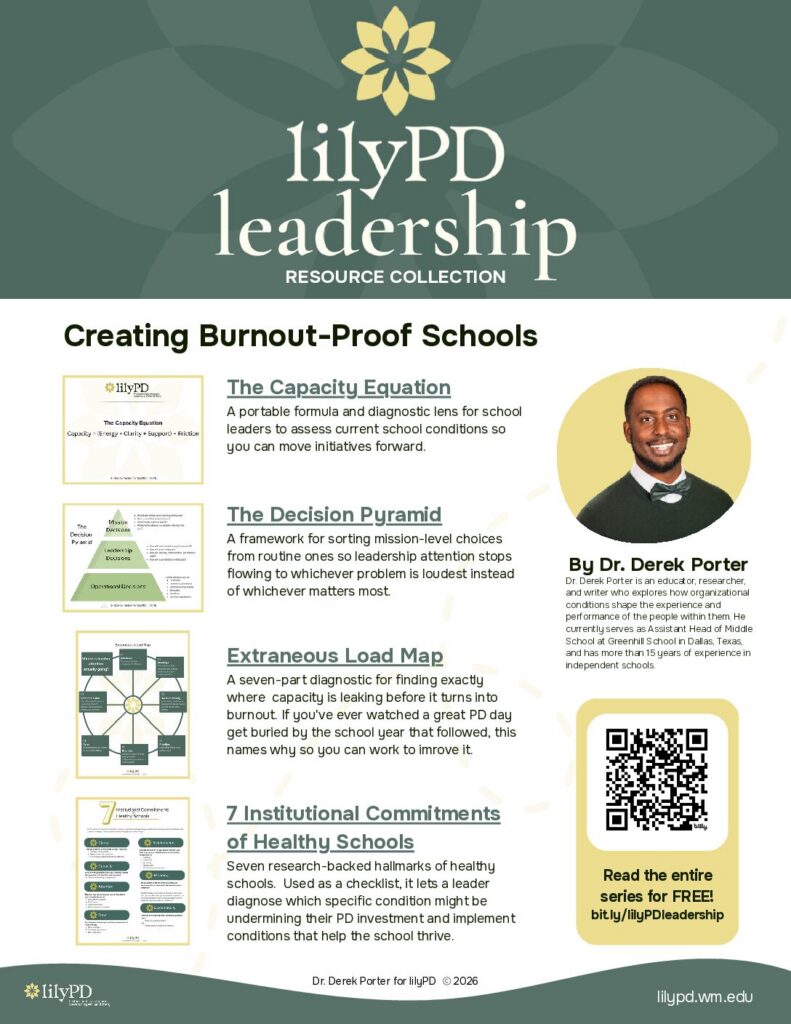
This is the second installment in a four-part leadership series! Get caught up on post 1, post 3, and post 4!

Why Good Professional Learning Doesn’t Change Practice
Professional learning is designed to help teachers grow. Every year, school leaders, like you, invest countless hours selecting meaningful topics, organizing coaching cycles, planning PLCs, and creating opportunities for educators to strengthen their practice. At lilyPD, we’re honored to partner with schools in that work.
Yet many of you eventually encounter a frustrating pattern. Teachers leave professional learning excited. They genuinely want to implement what they’ve learned. Then the school year accelerates.
A new initiative begins. Another committee meets. Emails multiply. Procedures change. Priorities compete for attention. Before long, even excellent professional learning begins collecting dust—not because teachers have stopped believing in it, but because the work of teaching has crowded out the work of implementing.
The challenge isn’t always the quality of professional learning. Often, it’s everything else…
Not All Work Moves Learning Forward
Several years ago, I asked a room full of educators a simple question: “How many of you feel like you’re working harder than ever?”
Every hand went up. Then I asked a second question: “How many of you believe you’re accomplishing more because of it?”
The room became noticeably quieter. A few people laughed. Most simply looked exhausted. That moment has stayed with me because it revealed something I now see in schools across the country.
Most educators are not avoiding hard work. They are wondering whether the work is making a meaningful difference. Like many other professionals, teachers too need to see a return on investment. Teachers willingly invest tremendous energy when they can see its impact on students, colleagues, or their own practice.
Cognitive Load Theory helps explain why.
Research tells us our working memory has limits. Every demand—whether meaningful or unnecessary—draws from the same finite pool. When educators devote increasing attention to work that produces little instructional value, they have less capacity available for the work that matters most. As competing demands accumulate, attention becomes fragmented, implementation slows, and even highly motivated teachers begin feeling constantly behind.
This is what I call extraneous load.
Extraneous load is any demand that consumes cognitive, emotional, or organizational capacity without meaningfully advancing student learning and professional growth. Unlike productive challenges, extraneous load is work that does not make people better. It simply makes them work harder and edge towards burnout.
The Hidden Cost
Extraneous load rarely announces itself. It hides inside everyday routines.
- A faculty meeting that could have been an email.
- Three different platforms communicating the same information.
- Multiple initiatives introduced simultaneously.
- Searching for documents that should be easy to find.
- Repeatedly explaining procedures because onboarding is inconsistent.
None of these frustrations seem particularly significant on their own. Together, however, they quietly drain the capacity teachers need to implement new learning.
Imagine introducing a new instructional strategy during a PD day. The speaker was engaging. The role playing and handouts were sleek. Teachers leave energized.
But during the following month, PLC conversations are dominated by scheduling issues for fieldtrips. Faculty meetings focus on operational announcements. Coaches spend their time answering logistical questions instead of supporting implementation. Teachers want to try, but there is simply no space left to practice.
Professional learning didn’t fail. The surrounding systems made implementation misaligned.
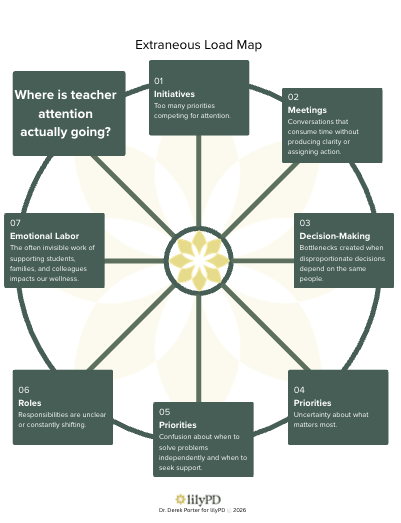
Introducing the Extraneous Load Map
If you are wondering why initiatives stall, try a diagnostic called the Extraneous Load Map. Rather than asking whether people feel busy, the framework asks a more useful question:
Where is teacher attention actually going?
The map helps you identify recurring friction across seven common areas:
- Initiatives — Too many priorities competing for attention.
- Meetings — Conversations that consume time without producing clarity or assigning action.
- Decision-Making — Bottlenecks created when disproportionate decisions depend on the same people.
- Priorities — Uncertainty about what matters most.
- Escalation Pathways — Confusion about when to solve problems independently and when to seek support.
- Roles — Responsibilities are unclear or constantly shifting.
- Emotional Labor — The often invisible work of supporting students, families, and colleagues impacts our wellness.
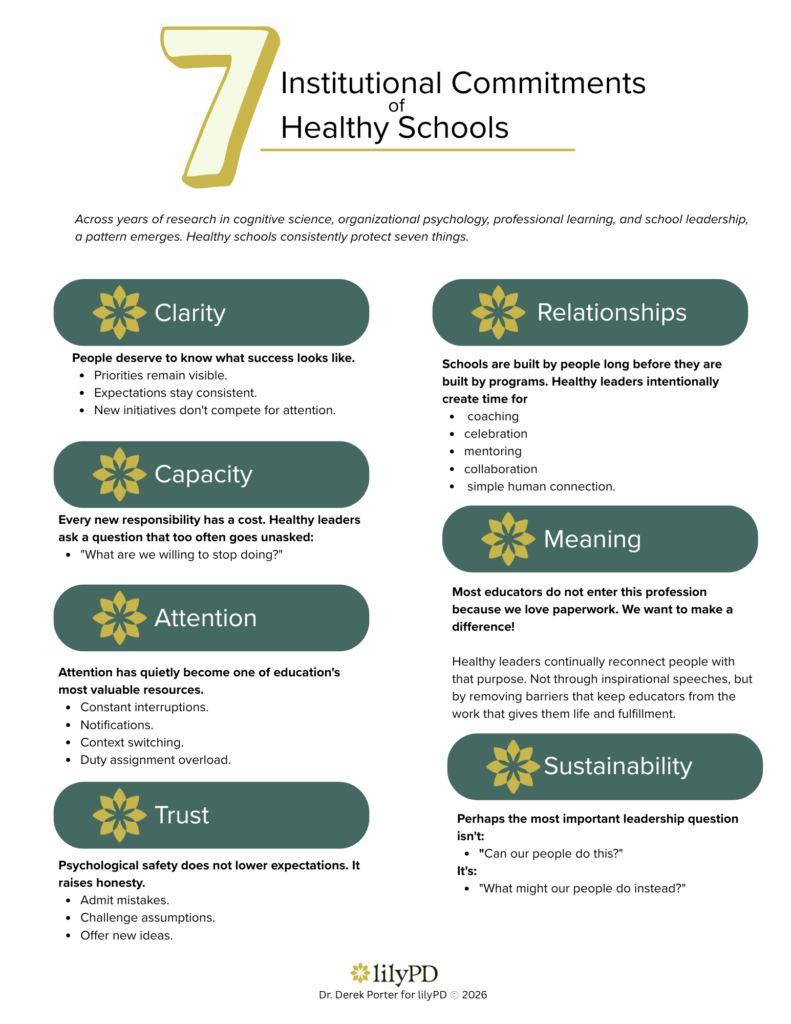
All schools experience every one of these categories. Healthy schools routinely identify and remove unnecessary friction before it becomes burnout. As you begin uncovering those patterns, lilyPD can help sustain the professional learning that follows through shared language, practical tools, and ongoing implementation support.
Protecting the Learning After the Learning
One of the biggest shifts you can make is recognizing that reducing workload isn’t the same as lowering expectations. In fact, the opposite is often true.
When schools eliminate unnecessary complexity, teachers have greater capacity to follow through, collaborate meaningfully, and deepen student learning. Professional learning succeeds when leaders intentionally protect the conditions required for implementation. That’s why reducing extraneous load isn’t simply an operational task. It’s instructional leadership.
Leadership Move
Before planning your next faculty meeting or PLC, ask teachers one simple question:
“What’s getting in the way of using what we’ve already learned?”
Notice that this question doesn’t ask teachers to identify new professional development needs. Instead, it uncovers the barriers preventing existing learning from taking root. As themes begin to emerge, resist the temptation to solve every problem immediately. Instead, choose one recurring source of friction and remove it. Small reductions in extraneous load can create large gains in implementation.
As your team creates more capacity, consider how lilyPD can support the work that follows. A shared microlearning course can provide common language, practical classroom strategies, and structured reflection that fits naturally into faculty meetings, PLCs, coaching conversations, or independent learning. When professional learning is paired with intentional implementation, growth becomes much more likely to last. Create space for educators to fully use the professional learning they have already received. Teachers don’t need more information nearly as often as they need more room to implement what they already know.
Next in the Series
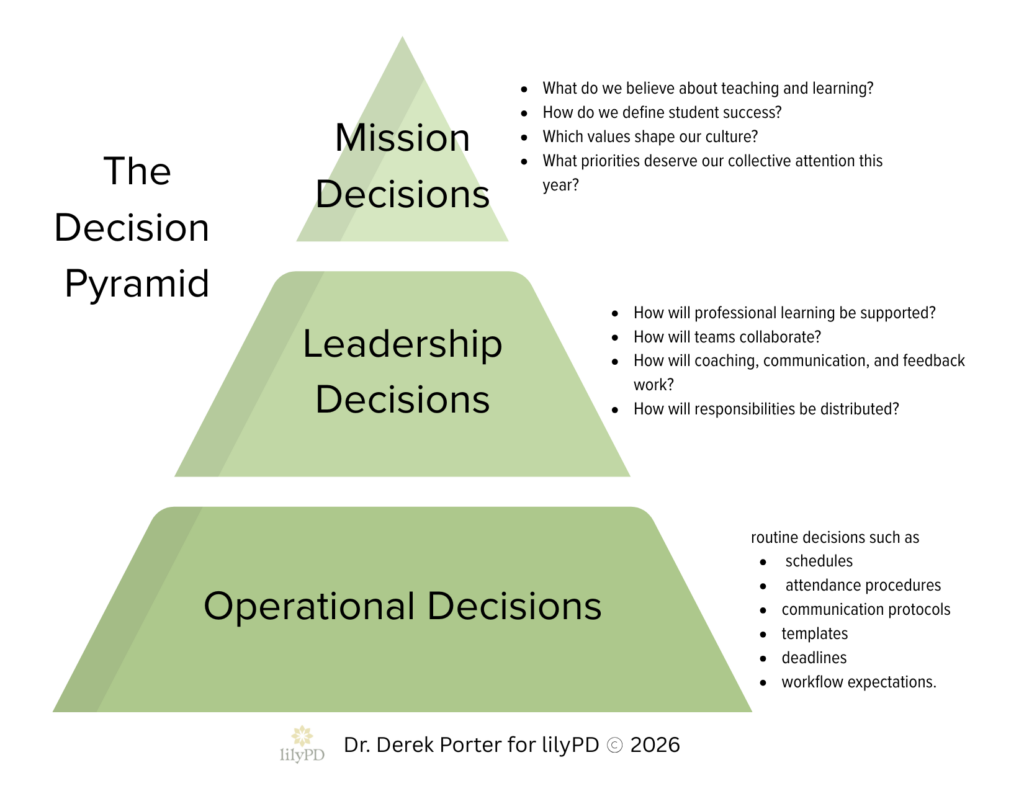
Reducing unnecessary work creates capacity. But protecting that capacity requires thoughtful decision-making.
In our next article, we’ll explore The Decisions Exhausting Every School and introduce the Decision Pyramid, a practical framework for reducing decision fatigue, clarifying priorities, and helping leadership teams spend their attention where it matters most.

Dr. Derek Porter is an educator, researcher, and writer who explores how organizational conditions shape the experience and performance of the people within them. He currently serves as Assistant Head of Middle School at Greenhill School in Dallas, Texas, and has more than 15 years of experience in independent schools. A graduate of William & Mary and Yale University, Derek’s work focuses on organizational design, professional learning, and sustainable performance. He consults and speaks about creating healthier school environments where educators can do meaningful work.











Log in to leave a comment