
Before You Plan Your Next PD Day, Ask This
This post is the first installment of a four-part leadership series. Check out part 2, part 3, and part 4!
“People don’t rise or fall to the level of their motivation. They rise or fall to the level of the systems they work within.”
Professional development is one of the most universally important investments schools make. At lilyPD, we believe leaders, like you, dedicate hours to selecting meaningful topics, inviting engaging presenters, organizing PLCs, scheduling coaching cycles, and creating opportunities for teachers to grow.
Yet many leaders have experienced the same frustrating reality. Teachers leave professional learning energized, but a few weeks later, very little has changed in their practice.
The assumption is often that teachers need more accountability, more follow-up, or simply more motivation. But what if the problem isn’t the professional learning itself? What if professional learning succeeds or fails because of the environment leaders create around it?
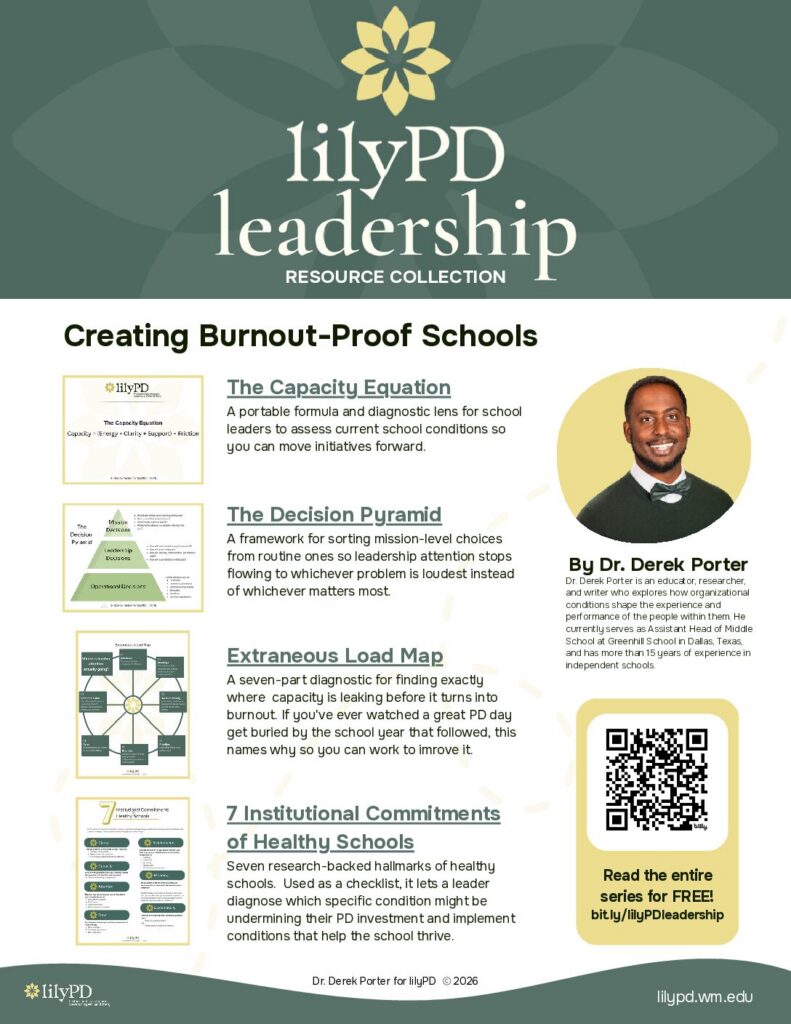
Throughout this series, we’ll explore four practical leadership frameworks that help schools create the conditions where professional learning leads to lasting change. Together, we will examine
- the Capacity Equation
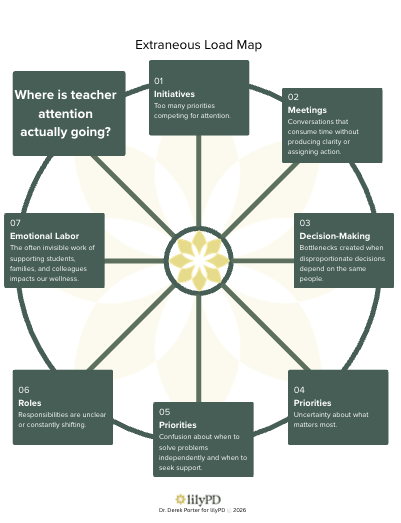
- the Extraneous Load Map
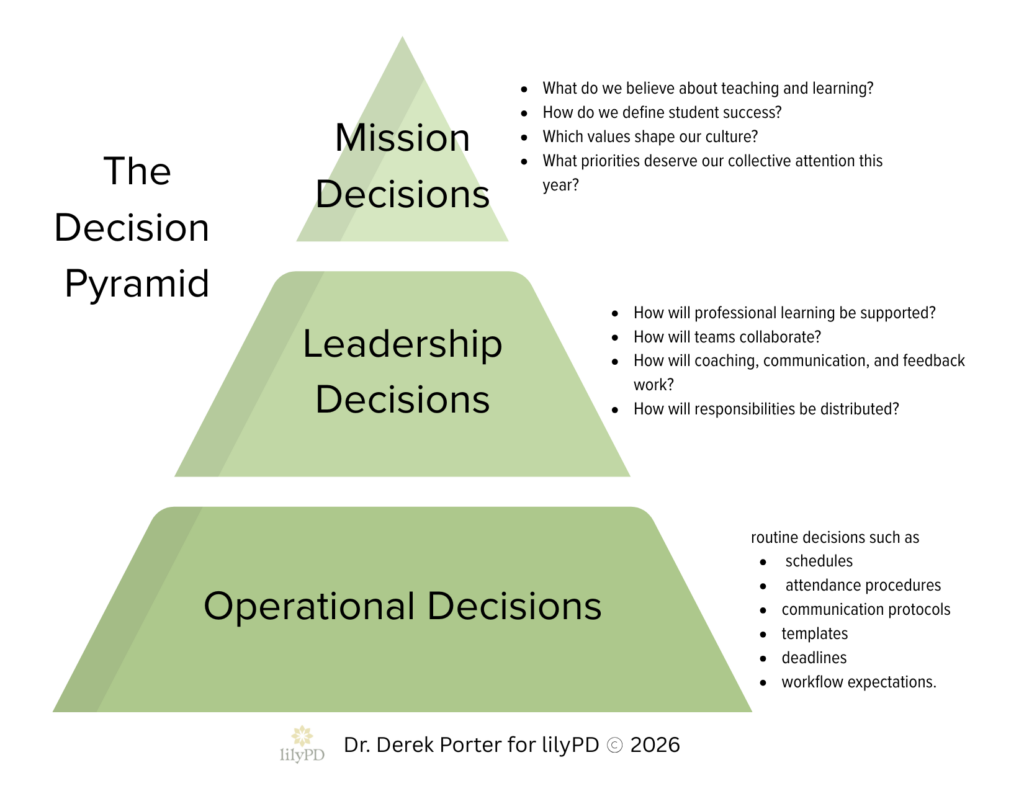
- the Decision Pyramid
- the Meeting Redesign Protocol
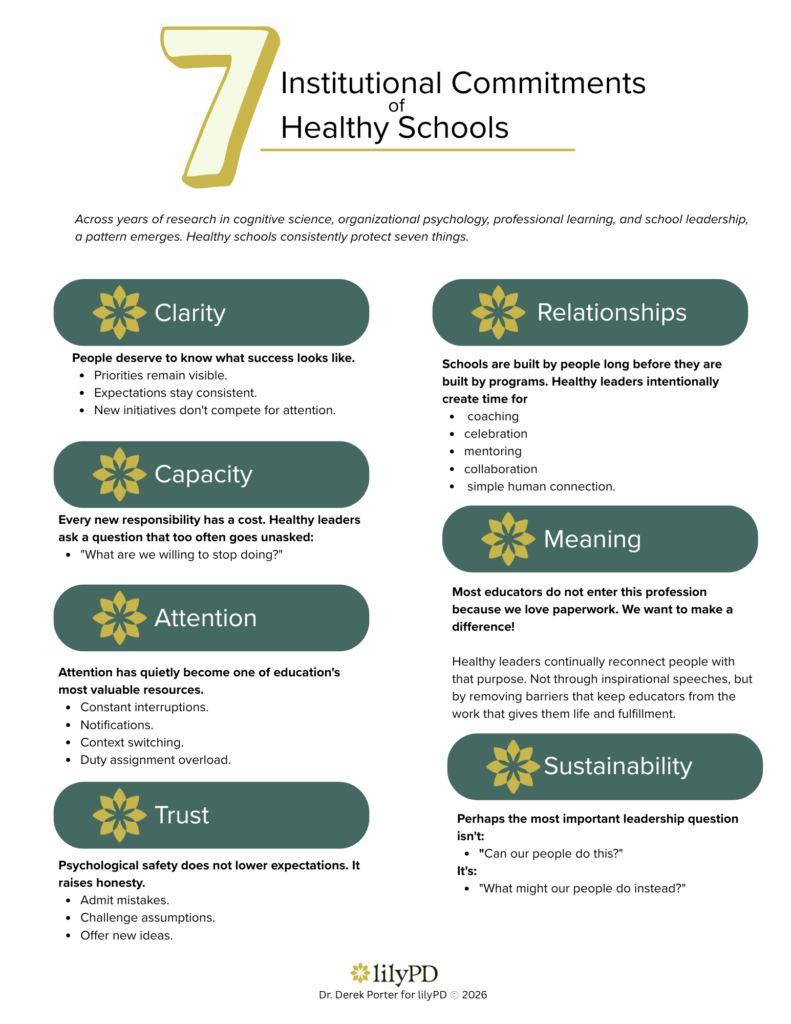
- and the Seven Institutional Commitments.
Each framework is designed to help us build healthier schools by intentionally designing the systems that support educators every day.
Professional Learning Doesn’t Happen by Accident
One of the biggest misconceptions in education is that improving professional learning simply means offering better professional development. While quality learning certainly matters, even outstanding professional learning struggles to create lasting change when educators lack the capacity to implement what they’ve learned.
Think about a school introducing a new advisory program.
In one school, teachers attend a summer workshop, receive new materials, and are expected to implement the program while juggling several other initiatives. Faculty meetings continue as usual. PLCs focus exclusively on curricular alignment and a new grading policy. Little time is provided to collaborate, reflect, or adjust instruction together for the student life experience.
In another school, leaders introduce the same third-party advisory program while intentionally creating space for implementation. PLCs become opportunities to plan together. Instructional coaches support teachers throughout the process during student life, not just core instructional minutes. Simplify competing priorities so teachers can focus on doing well instead of it all.
Same subscription based advisory program.
Same divisional onboarding meeting.
Yet different results.
The difference isn’t teacher commitment. It’s organizational design. It is ongoing structured support. Professional learning doesn’t happen in isolation. It succeeds or fails because of the systems you intentionally—or unintentionally—create around it.
Capacity Is More Than Time
When educators describe feeling overwhelmed, our first instinct is often to assume they simply need more time.
Sometimes they do. More often, they need more capacity.
Capacity is the mental, emotional, and cognitive space educators have available to learn, make thoughtful decisions, build relationships, and apply new ideas to their practice. Research on cognitive load reminds us that working memory is limited. Every unnecessary decision, unclear expectation, competing initiative, or inefficient process consumes cognitive resources that could otherwise be devoted to teaching, learning, and meaningful collaboration.
This has implications for school leaders. Professional learning rarely fails because teachers don’t want to grow. It often fails because there isn’t enough capacity left to apply what they’ve learned. Application—not simply instruction—is where many implementation plans break down.
Introducing the Capacity Equation
Over the years, I’ve found myself returning to one simple framework that helps explain why some schools sustain meaningful growth while others struggle to move initiatives forward.
I call it the Capacity Equation.
Capacity = (Energy + Clarity + Support) – Friction
Each part matters.
Energy comes from meaningful work, healthy relationships, and opportunities to recover. Clarity grows when priorities, expectations, and decision-making processes are consistent and transparent. Support develops through coaching, collaboration, trust, and psychological safety.
Then there’s friction. Friction subtracts from everything else. Unnecessary meetings. Conflicting initiatives. Duplicate work. Unclear communication. Competing priorities. Constant interruptions. Inconsistent schedules.
None of these challenges may seem significant on their own. Together, however, they create organizational drag—the small, persistent resistance that steadily consumes the attention and energy educators need to do their best work.
Leaders rarely notice this drag because no single policy appears broken. Teachers experience the cumulative weight every day.
Leadership Begins Before the Learning Begins
We often think of professional development as something leaders deliver. In reality, leadership begins long before anyone enters a workshop or logs into an online course. Every faculty meeting. Every PLC. Every coaching conversation. Every communication. Every priority.
The most effective instructional leaders don’t simply ask, “What do our teachers need to learn?” They also ask, “What conditions do we need to create so teachers can successfully use what they learn?”
That’s a fundamentally different leadership posture. And it’s one that has the power to transform professional learning from an event into lasting organizational growth.
Leadership Move
Before planning your next professional learning session, faculty meeting, or PLC, ask your teachers one simple question:
“What’s one recurring responsibility that no longer improves student learning?”
Listen without defending existing systems. Look for patterns rather than isolated frustrations. The patterns which arise often reveal what is reducing capacity to implement new learning.
As you begin identifying opportunities to reduce friction, consider how lilyPD can partner. As a team, choose a lilyPD course (or three!) and enroll. Shared professional learning can help create a common language across your faculty. Whether you’re planning a PD day, facilitating PLCs, or supporting instructional coaches, thoughtfully designed microlearning experiences and practical leadership resources—like those available through lilyPD—can help leadership teams strengthen capacity one intentional step at a time. At the end of the course, you can download a certificate of completion, signed by the William & Mary School of Education, awarding 5 hours of credit.
Sometimes the most powerful professional development decision isn’t choosing what to add. It’s deciding what no longer deserves to be carried by your community.
Next in the Series
In our next article, we’ll explore one of the biggest barriers to meaningful professional learning: extraneous load—the unnecessary complexity that quietly steals teachers’ attention, energy, and implementation capacity.
You will be introduced to the Extraneous Load Map, a practical framework for identifying organizational friction before it becomes burnout and for creating the conditions where professional learning can truly take root.
References (MLA)
Edmondson, Amy C., and Mark Mortensen. “What Psychological Safety Looks Like in a Hybrid Workplace.” Harvard Business Review, 2021.
Learning Forward. Standards for Professional Learning. Learning Forward, 2022.
Maslach, Christina, and Michael P. Leiter. The Burnout Challenge: Managing People’s Relationships with Their Jobs. Harvard Business Review Press, 2022.
Organisation for Economic Co-operation and Development. Teachers and School Leaders as Lifelong Learners: Insights from TALIS 2024. OECD Publishing, 2024.
Sull, Donald, Charles Sull, and Ben Zweig. “Toxic Culture Is Driving the Great Resignation.” MIT Sloan Management Review, 2022.
Sweller, John. “Cognitive Load During Problem Solving: Effects on Learning.” Cognitive Science, vol. 12, no. 2, 1988, pp. 257–285.

Dr. Derek Porter is an educator, researcher, and writer who explores how organizational conditions shape the experience and performance of the people within them. He currently serves as Assistant Head of Middle School at Greenhill School in Dallas, Texas, and has more than 15 years of experience in independent schools. A graduate of William & Mary and Yale University, Derek’s work focuses on organizational design, professional learning, and sustainable performance. He consults and speaks about creating healthier school environments where educators can do meaningful work.










Log in to leave a comment