
This is the third installment in our lilyPD X leadership series! Check out post 1, post 2, and post 4!

The Decisions Exhausting Every School
“The quality of a school is often determined not by its biggest decisions, but by the thousands of smaller ones that quietly shape people’s days.”
Professional learning asks educators to grow. Every new strategy, instructional practice, and leadership framework invites teachers to think differently about their work. At lilyPD, we believe that kind of learning is worth the investment.
Imagine it’s only 9:15 on a Tuesday morning.
A teacher has already adjusted a lesson after the printer jammed, responded to three student questions, redirected two classroom behaviors, answered a parent email, and wondered whether the newest initiative should take priority over the last one.
Every school day is filled with decisions. Some are instructional. Others are operational. Some are deeply meaningful. Others feel routine. Yet together, they create an invisible workload that many overlook. Together, they quietly consume attention long before first period is over.
When Every Decision Competes for Attention
Behavioral researchers have long recognized that our capacity for thoughtful decision-making is finite. As the number of choices accumulates throughout the day, our ability to prioritize, think strategically, and regulate emotions begins to decline. By late afternoon, even relatively simple decisions can feel surprisingly difficult—not because educators have become less capable, but because their mental energy has been repeatedly taxed.
Teaching is already one of the most decision-intensive professions. Teachers make hundreds, sometimes well over a thousand, decisions each day as they respond to students, adjust instruction, manage classrooms, communicate with families, and navigate school systems.
Professional learning can add another set of decisions.
- How should I implement this strategy?
- What adjustments do I need to make to this unit to make this strategy work?
- When will I practice, or do I have to try it cold with students?
- Which students need it first?
- Who will need which accommodations?
- How does it fit alongside everything else I’m already doing?
Teachers need to make most of these decisions. The problem is that they are competing with dozens of unnecessary ones.
When Everything Feels Important…
One of the fastest ways to exhaust a faculty is to make every initiative, request, and problem feel equally urgent. When educators struggle to distinguish between:
- mission-critical decisions,
- important implementation decisions,
- routine operational decisions, and
- decisions that require little attention at all,
they begin operating in a constant state of mental triage. Over time, three predictable patterns emerge.
- Decision fatigue. People become mentally depleted, lacking the energy to decide.
- Decision avoidance. Important choices are delayed because everything feels overwhelming.
- Decision bottlenecks. Increasing numbers of decisions are escalated to administrators because expectations and ownership remain unclear.
Introducing the Decision Pyramid
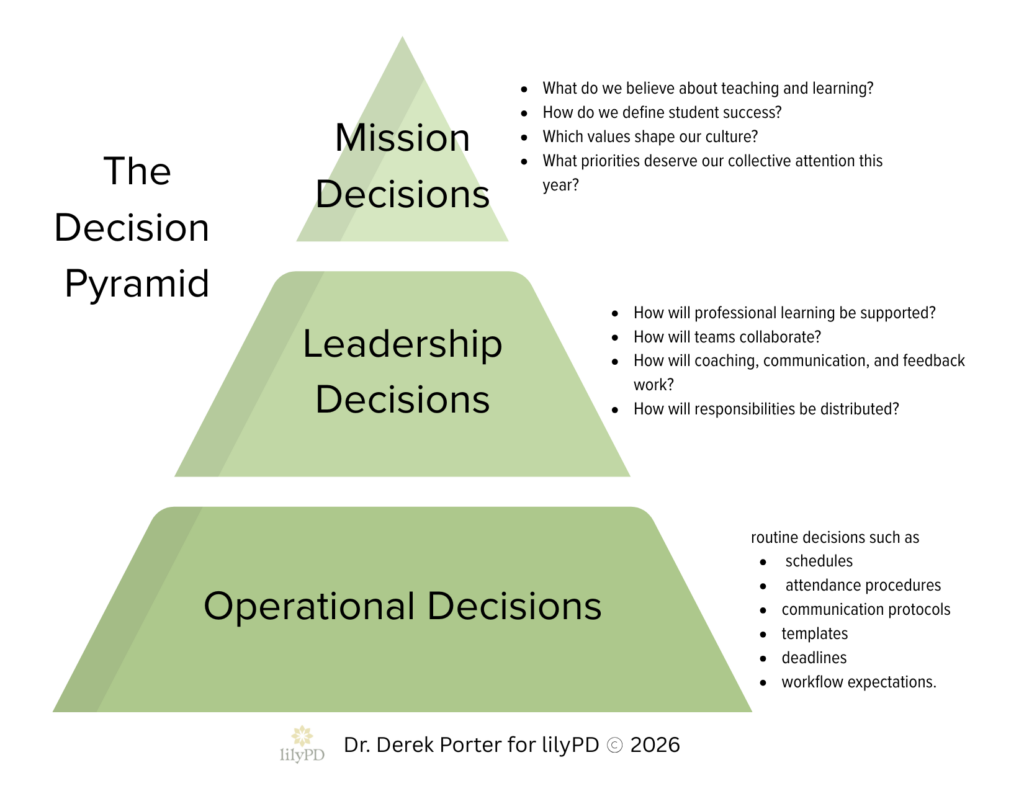
One framework to help leadership teams simplify this complexity is the Decision Pyramid.
Rather than treating every decision as equally important, the pyramid organizes decisions according to their organizational impact.
Level 1: Mission Decisions
At the top are the decisions that define who we are as a school.
- What do we believe about teaching and learning?
- How do we define student success?
- Which values shape our culture?
- What priorities deserve our collective attention this year?
These conversations deserve thoughtful discussion because they influence everything beneath them.
Level 2: Leadership Decisions
The middle level focuses on implementation.
- How will professional learning be supported?
- How will teams collaborate?
- How will coaching, communication, and feedback work?
- How will responsibilities be distributed?
These decisions shape daily experience and determine whether great ideas become consistent practice.
Level 3: Operational Decisions
The foundation includes routine decisions such as schedules, attendance procedures, communication protocols, templates, deadlines, and workflow expectations.
These decisions certainly matter, but they should consume the least amount of organizational attention.
When the Pyramid Flips Upside Down
Many schools unintentionally invert the pyramid.
Operational decisions begin receiving mission-level attention.
- Entire leadership meetings become consumed by calendar logistics.
- Faculty spend weeks refining handbook language.
- Email threads stretch for days over procedures that could be resolved in minutes.
Meanwhile, conversations about instructional quality, teacher growth, belonging, student experience, and organizational culture receive whatever time remains.
The issue isn’t that operational work lacks importance. It’s proportionality. When low-impact decisions consistently receive high-impact attention, organizations become busy without becoming better.
One leadership principle has stayed with me for years:
Use company time for company problems.
Mission-level conversations shouldn’t be squeezed into early morning coffee meetings or weekend pickleball games because the workday was consumed by logistics. Leaders, like you, must protect time for the conversations that matter most.
Decision Fatigue Is an Organizational Design Challenge
One of the greatest misconceptions in leadership is believing decision fatigue is primarily an individual problem. It isn’t. More often, it’s an organizational design problem.
Consider a few examples.
- A teacher receives conflicting guidance from multiple administrators.
- A department lacks clear expectations for grading or assessment.
- Faculty repeatedly seek approval for decisions they are already empowered to make.
- Meeting outcomes remain vague, requiring multiple follow-up conversations.
None of these challenges reflect a lack of commitment. They reveal systems that require unnecessary thinking. LilyPD partners with you to intentionally reduce this noise.
When priorities are clear, fewer decisions are required. When expectations are consistent, fewer interpretations become necessary. When trust exists, educators can confidently act without constantly seeking permission.
Good systems make good decisions easier.
Leadership Move
Before your next leadership meeting, ask one simple question:
“Which decisions consume the most energy while contributing the least value to student learning?”
Don’t rush to solve. Instead, look for patterns because patterns reveal systems. Systems reveal opportunities for redesign.
As your team simplifies unnecessary decisions, consider how lilyPD can support the learning that follows. Shared microlearning experiences create common language, collaboration, and instructional practice, allowing teams to spend less energy rediscovering expectations and more energy improving student learning and coaching teachers.
Professional learning becomes far more powerful when educators have the capacity to act on it. Most times we do not need a better decision; we need to eliminate decisions.
Next in the Series
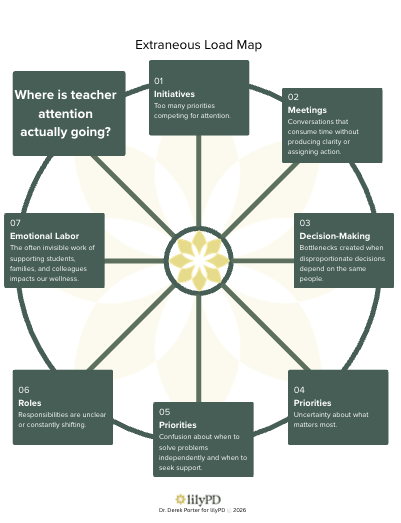
Throughout this series we’ve explored the hidden forces that quietly shape educator well-being: cognitive load, decision fatigue, and organizational ambiguity.
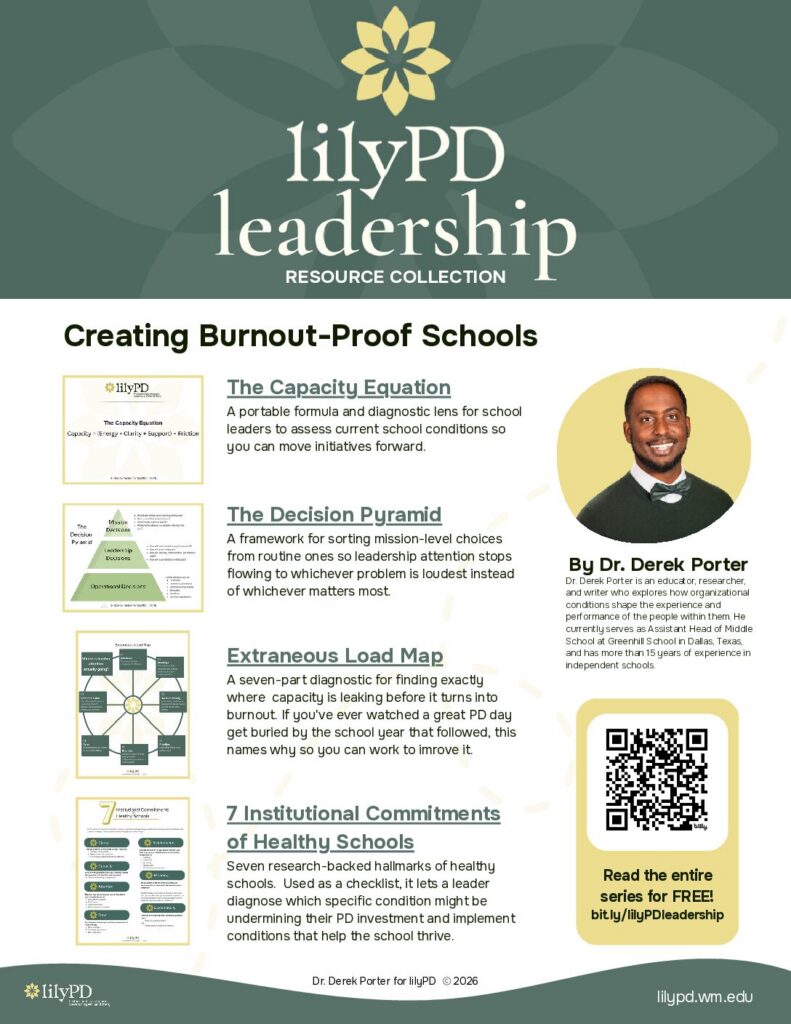
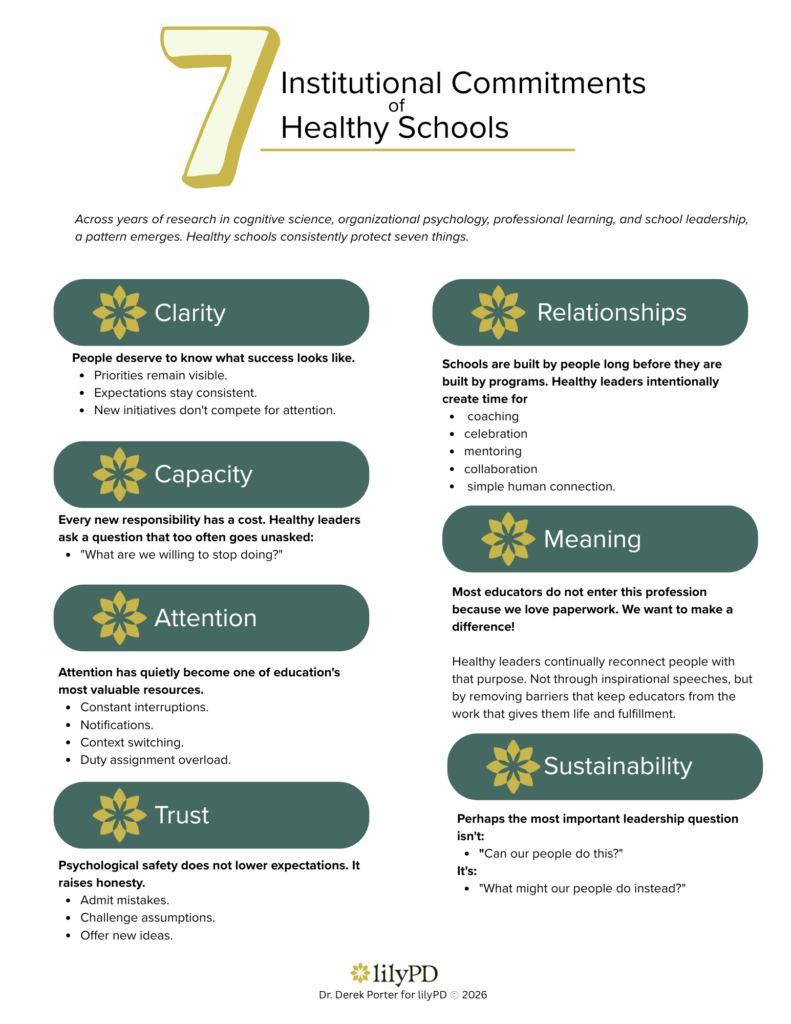
In our final article, we’ll bring these ideas together by introducing the Seven Institutional Commitments—a leadership framework that helps schools intentionally create the conditions where educators can sustain excellence without sacrificing themselves.
References (MLA)
DeChurch, Leslie A., et al. “Teams and Team Effectiveness.” Annual Review of Organizational Psychology and Organizational Behavior, vol. 8, 2021, pp. 17–41.
Edmondson, Amy C., and Mark Mortensen. “What Psychological Safety Looks Like in a Hybrid Workplace.” Harvard Business Review, 2021.
Kahneman, Daniel. Thinking, Fast and Slow. Farrar, Straus and Giroux, 2011.
Maslach, Christina, and Michael P. Leiter. The Burnout Challenge: Managing People’s Relationships with Their Jobs. Harvard Business Review Press, 2022.
Organisation for Economic Co-operation and Development. Teachers and School Leaders as Lifelong Learners: Insights from TALIS 2024. OECD Publishing, 2024.
Sull, Donald, et al. “Toxic Culture Is Driving the Great Resignation.” MIT Sloan Management Review, 2022.
Sweller, John. “Cognitive Load During Problem Solving: Effects on Learning.” Cognitive Science, vol. 12, no. 2, 1988, pp. 257–285.

Dr. Derek Porter is an educator, researcher, and writer who explores how organizational conditions shape the experience and performance of the people within them. He currently serves as Assistant Head of Middle School at Greenhill School in Dallas, Texas, and has more than 15 years of experience in independent schools. A graduate of William & Mary and Yale University, Derek’s work focuses on organizational design, professional learning, and sustainable performance. He consults and speaks about creating healthier school environments where educators can do meaningful work.












Log in to leave a comment