
This is the final installment of our four-part leadership series with Dr. Derek Porter. You can get caught up on the rest of the series here: post 1, post 2, post 3.
How Healthy Schools Protect People’s Capacity
The Seven Institutional Commitments of Sustainable Leadership
“Culture is not built by what leaders believe. It is built by what leaders protect.”
Every school leader I know entered education to help people flourish. Few set out to create bureaucracy, design confusing systems, overwhelm teachers, or create cultures where talented educators quietly burn out.
Yet those outcomes persist.
Not because leaders lack compassion. Because organizational health is never the product of good intentions alone. It is the result of thousands of leadership decisions repeated over time.
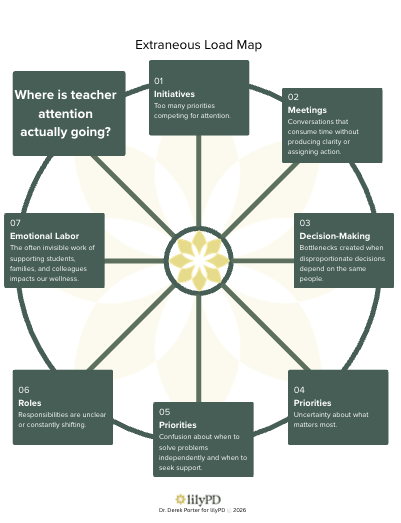
At lilyPD, we believe motivation alone cannot overcome poorly designed professional learning systems. Throughout this series, we’ve explored how organizational design shapes the educator experience. We’ve explored how cognitive overload quietly erodes decision-making, how organizational ambiguity drains capacity, and how meetings communicate what an institution truly values.
Each article points toward the same conclusion:
Healthy schools are not accidental. They are intentionally designed. More importantly, they are intentionally protected.
That protection requires commitments. Not initiatives. Not slogans.
Commitments.
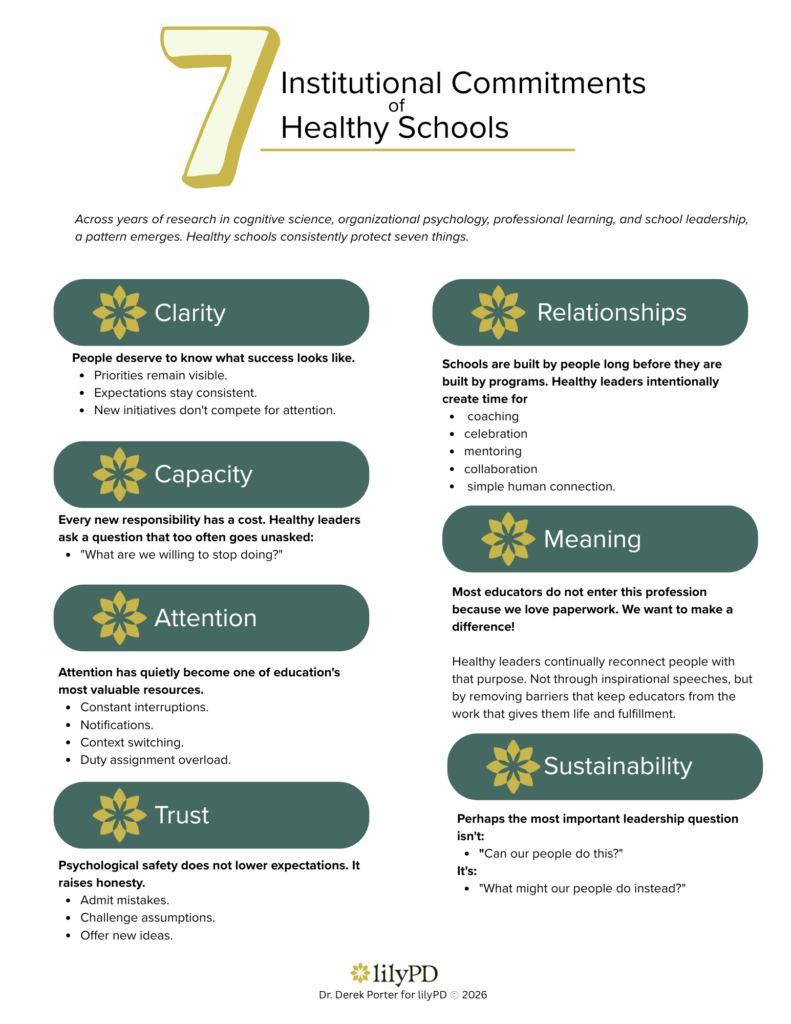
The Seven Institutional Commitments
Across years of research in cognitive science, organizational psychology, professional learning, and school leadership, I continue to notice the same pattern. Healthy schools consistently protect seven things.
1. Clarity
People deserve to know what success looks like.
- Priorities remain visible.
- Expectations stay consistent.
- New initiatives don’t compete for attention.
When people understand where the organization is headed, they spend less energy interpreting and more energy contributing. Clarity reduces cognitive load long before it reduces stress.
2. Capacity
Every new responsibility has a cost. Healthy leaders ask a question that too often goes unasked:
- “What are we willing to stop doing?”
If nothing comes off the plate, nothing new truly fits. Capacity isn’t created by asking people to work harder. It is created by designing systems that make quality work sustainable.
3. Attention
Attention has quietly become one of education’s most valuable resources.
- Constant interruptions.
- Notifications.
- Context switching.
- Duty assignment overload.
Healthy schools defend attention because attention fuels everything else—learning, creativity, relationships, and sound judgment.
4. Trust
Psychological safety does not lower expectations. It raises honesty.
- Admit mistakes.
- Challenge assumptions.
- Offer new ideas.
Innovation begins where fear ends.
5. Relationships
Schools are built by people long before they are built by programs. Healthy leaders intentionally create time for coaching, celebration, mentoring, collaboration, and simple human connection.
Belonging is rarely created during special events. It grows through thousands of ordinary interactions.
6. Meaning
Most educators do not enter this profession because we love paperwork.
We want to make a difference! Healthy leaders continually reconnect people with that purpose. Not through inspirational speeches, but by removing barriers that keep educators from the work that gives them life and fulfillment.
7. Sustainability
Perhaps the most important leadership question isn’t:
- “Can our people do this?”
It’s:
- “What might our people do instead?”
Healthy organizations dream. Then design that hope for endurance rather than heroics. They do not depend upon twenty percent of the staff carrying eighty percent of the work. Instead, we build systems where ordinary people can consistently accomplish extraordinary things together.
That is sustainable excellence. That is what every family deserves.
Sustainable Leadership Is Organizational Stewardship
Notice what these commitments have in common.
- None require charisma.
- None depend on larger budget allocations.
- None require attending a national conference.
Instead, they require leaders, like us. We see ourselves less as firefighters and more as architects. We dare to ask different questions.
- Where is stress accumulating?
- How does this committee yield mission fulfilment?
- Which policy grates against trust?
These questions rarely produce dramatic change overnight. Instead, they produce something far more valuable:
Healthier organizations year by year.
Leadership Reflection
Looking across these seven commitments, ask yourself:
- Which commitment is most consistently protected in our school?
- Which commitment is most consistently neglected?
- How can I strengthen that commitment this semester?
The answers often reveal where leadership matters most. Because leadership is rarely defined by the speeches we give. It is defined by what we protect.
From Commitment to Practice
Of course, protecting capacity requires more than good intentions.
Professional learning is most effective when it reduces organizational complexity. Shared, research-informed experiences create common language, strengthen coaching conversations, and reduce the need for people to continually reinterpret expectations. Platforms like lilyPD support that work by making professional learning practical, accessible, and immediately applicable, allowing educators to spend less energy navigating systems and more energy serving students.
The best schools understand that professional learning is not acquiring new knowledge. It is about synchronized expectations horizontally and vertically within a school community.
Closing the Series
Over these four articles, we’ve returned to one central idea:
People are rarely the problem. More often, we are responding rationally to the systems surrounding us.
When leaders intentionally reduce friction…
- clarify priorities…
- design meaningful moments rather than more meetings…
- and build organizations around sustainable human capacity…
something remarkable happens.
- Educators regain the space to teach creatively.
- Students experience adults who are present rather than depleted.
- Professional learning becomes easier to implement.
Schools become places where trust and excellence are normalized and enjoyed. Perhaps that is the ultimate responsibility of leadership. Not demanding we carry more. Helping us carry what matters most.
References (MLA)
Colquitt, Jason A., et al. “Justice at the Millennium: A Meta-Analytic Review of 25 Years of Organizational Justice Research.” Journal of Applied Psychology, vol. 86, no. 3, 2001, pp. 425–445.
DeChurch, Leslie A., et al. “Teams and Team Effectiveness.” Annual Review of Organizational Psychology and Organizational Behavior, vol. 8, 2021, pp. 17–41.
Edmondson, Amy C., and Mark Mortensen. “What Psychological Safety Looks Like in a Hybrid Workplace.” Harvard Business Review, 2021.
Maslach, Christina, and Michael P. Leiter. The Burnout Challenge: Managing People’s Relationships with Their Jobs. Harvard Business Review Press, 2022.
Organisation for Economic Co-operation and Development. Teachers and School Leaders as Lifelong Learners: Insights from TALIS 2024. OECD Publishing, 2024.
Sull, Donald, et al. “Toxic Culture Is Driving the Great Resignation.” MIT Sloan Management Review, 2022.
Sweller, John. “Cognitive Load During Problem Solving: Effects on Learning.” Cognitive Science, vol. 12, no. 2, 1988, pp. 257–285.

Dr. Derek Porter is an educator, researcher, and writer who explores how organizational conditions shape the experience and performance of the people within them. He currently serves as Assistant Head of Middle School at Greenhill School in Dallas, Texas, and has more than 15 years of experience in independent schools. A graduate of William & Mary and Yale University, Derek’s work focuses on organizational design, professional learning, and sustainable performance. He consults and speaks about creating healthier school environments where educators can do meaningful work.









Log in to leave a comment