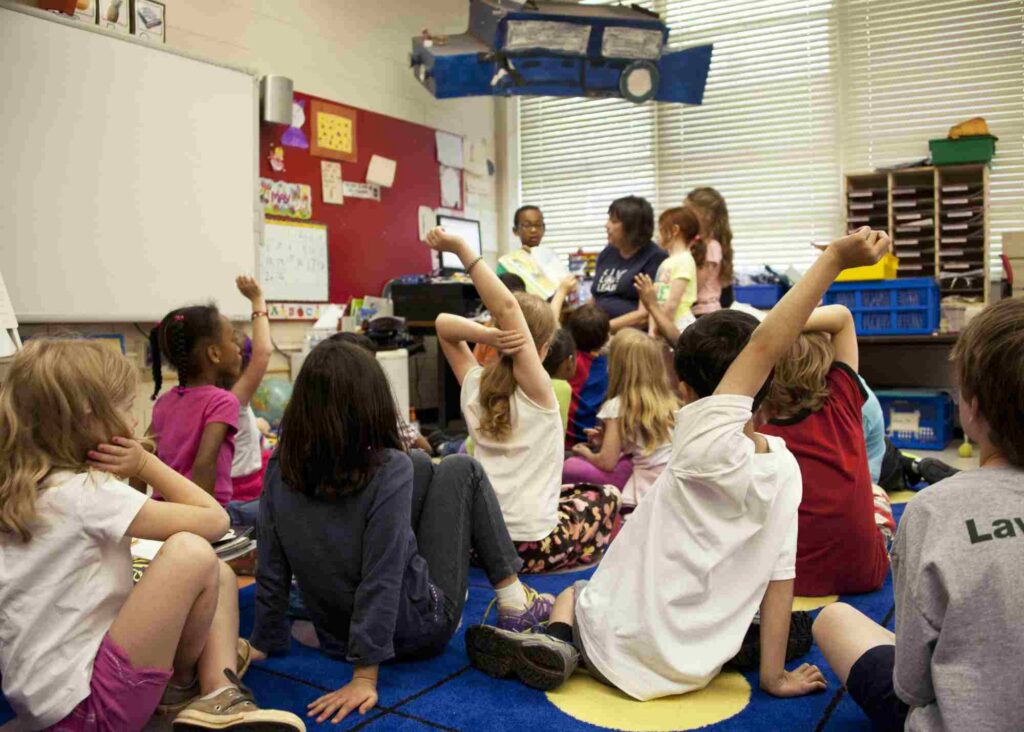

There is a lot happening in a classroom discussion.
Students are listening to someone else’s ideas, deciding whether they agree or disagree, connecting those ideas to what they already know, looking for evidence, and figuring out what they want to say next, all while the conversation keeps moving.
For multilingual learners (MLs), there may be one more layer to that process: finding the English to express an idea they may already understand perfectly well.
That distinction matters.
A student who pauses before responding may not be struggling with the content. A student who is quiet during a whole-class discussion may have plenty to contribute. Sometimes students simply need more time, or a little more language support, to bring their thinking into the conversation.
So, how can we make rich classroom discussions more accessible to multilingual learners without lowering the intellectual demand? The answer may be simpler than we think.
Here are four small shifts that can make a big difference.
1. Give Students the Language of Discussion
Think about everything students are expected to do with language during a discussion: agree, disagree, clarify, build on someone’s idea, introduce evidence, and invite others into the conversation.
We don’t always explicitly teach what those moves sound like. Research on multilingual learners reminds us that teachers may need to explicitly model classroom activities and explain the academic language that English-proficient students may already know (Mavrogordato et al., 2024).
A few sentence stems can help!
These aren’t scripts students need forever. Think of them as temporary supports that make the language of academic discussion visible.
2. Give Students Thinking Time Before Speaking Time
Here’s an easy change to try tomorrow.
Instead of asking, “What do you think?” and immediately waiting for hands to go up, give students two minutes to write first.
Try prompts like:
My opinion is…
One piece of evidence is…
One question I still have is…
For multilingual learners, those two minutes provide time to process the question, organize an idea, find the language to express it, and prepare to speak.
You can also build toward whole-class discussion through lower-risk activities like partner rehearsals, Gallery Walks, or Silent Round Tables (one of many useful strategies discussed in the Civil Discourse in the Classroom course.)
3. Let Thinking Happen in More Than One Language
Try telling students:
Your notes are for your thinking. Use whichever language helps you organize your ideas best.
A student might brainstorm in Arabic, annotate a source in Spanish and English, or jot down an idea in another home language before working out how to communicate it in English.
This practice, often called translanguaging, allows multilingual learners to draw on their full linguistic repertoire while learning. A recent systematic review found that translanguaging can support meaning-making, participation, and disciplinary learning for multilingual students (Kim et al., 2026).
The home language isn’t replacing English participation. It’s helping students get there.
4. Assess the Thinking You Actually Want to See
If the goal of a civil discourse activity is reasoning and discussion, what does success really look like?
Did the student use evidence? Listen respectfully? Ask a meaningful question? Build on another person’s idea? Explain their reasoning?
If so, a grammatical error shouldn’t erase everything they did well.
Research on multilingual assessment similarly suggests that allowing students to draw on their linguistic resources can provide more authentic opportunities to demonstrate what they know (Tian et al., 2025).
When English accuracy isn’t the learning objective, we can assess the quality of students’ reasoning without allowing language proficiency to overshadow it.
Try this in your next class
You don’t need to redesign your next discussion.
Choose three to five essential vocabulary words. Give students the discussion question ahead of time when possible. Provide two minutes of thinking or writing time and a few sentence stems. Then listen for the quality of their reasoning, not just the accuracy of their English.
Small changes can make a big difference in who gets to participate.
Supporting multilingual learners doesn’t mean making the thinking easier. It means making participation more accessible.
And when more students have the tools and confidence to enter the conversation, civil discourse becomes what we want it to be: a space where more voices can genuinely be heard.
Want to Keep Exploring?
The lilyPD Civil Discourse in the Classroom course explores strategies, and ready-to-use resources, for creating productive classroom discussions, including scaffolding discourse, establishing norms and routines, and aligning discussion with instructional goals.
References for Further Reading
Kim, S., Zhao, M., Kim, W., Ayik, B., Gu, D., Chen, X., Zan, Y., & Ramos, K. A. (2026). Supporting multilingual learners through translanguaging pedagogy in U.S. K–12 STEM classrooms: A systematic meta-synthesis. Education Sciences, 16(3), 376. https://doi.org/10.3390/educsci16030376
Mavrogordato, M., & colleagues. (2024). Supports for multilingual students who are classified as English learners (EdResearch for Action Brief No. 15). EdResearch for Action.
Tian, Z., Schissel, J. L., Yin, C.-H., & McConnell, J. W. (2025). Translanguaging for equity and justice in assessment: A systematic review. Education Sciences, 15(11), 1567. https://doi.org/10.3390/educsci15111567

Shaimaa Ibrahim is a Ph.D. candidate in Higher Education Administration at William & Mary. Her research focuses on institutional policies and support systems that promote student success. She also holds a master’s degree in Linguistics and brings more than a decade of experience in TESOL, supporting English learners and multilingual students across K–12, university, and adult education settings, with particular attention to inclusive teaching practices, academic language development, and equitable participation.