Your learning journey
About this course
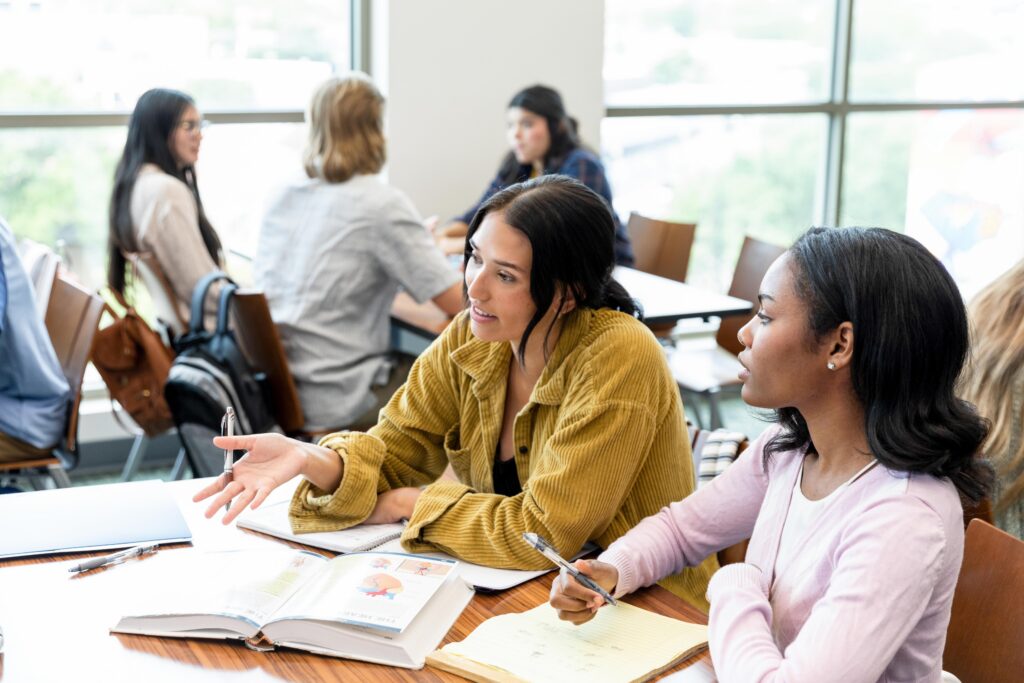
Civil discourse is at the heart of democratic education. This course introduces educators to a research-backed framework for facilitating productive, respectful dialogue in classrooms of all levels. You will learn to create structured spaces where students can engage with diverse perspectives, develop critical thinking skills, and practice the art of reasoned argumentation. The course recognizes civil discourse as one of the most effective teaching tools available, proven to significantly improve content knowledge acquisition and literacy skills for all learners, including English Language Learners.
Educators will learn to move beyond the fear of conflict by building a professional “insurance policy” through proactive stakeholder communication. By engaging administrators and families as partners, you can create the support system necessary to navigate politically charged topics with confidence. The course emphasizes the importance of scaffolding, guiding teachers to transition intentionally from low-stakes, high-interest topics to weightier historical and contemporary issues once a firm culture of trust has been established.
Through a combination of theory, practical exercises, and peer collaboration, you will build the confidence and skills needed to guide students through challenging conversations. Whether addressing current events, historical debates, or ethical dilemmas, the strategies in this course are designed to be adaptable to any subject area and grade level and to help teachers navigate high-emotion moments and maintain a safe and rigorous learning environment.
This course is available at no cost to educators through the We the Teachers initiative, made possible by a U.S. Department of Education grant.
Details
Includes
Shareable PD Certificate
Aligned With
Assessment Types
Accessibility
What you’ll learn
Master Core Concepts
- Define civil discourse with a focus on classroom application.
- Explain the benefits of integrating structured dialogue into your teaching practice.
Develop Facilitation Skills
- Evaluate a range of discussion frameworks and protocols.
- Acquire hands-on experience through practical exercises designed for your classroom context.
Apply Your Skills in Context
- Design impactful classroom discussions around civil discourse.
- Learn how to implement and assess them in line with curriculum goals and learning objectives.
Demonstrate Your Learning
- Complete assessments that demonstrate your new capabilities and document your progress.
- Receive feedback from your peers and leverage a diverse range of supplementary resources.
Skills you’ll gain
Strategies & frameworks you’ll encounter
Learning science moments

Think²
A pause from the core content to reflect on a research-backed pedagogical strategy that you can use today to deepen student learning.
Think² Shared
Consider your students’ perspectives and empower them to take charge of their own learning.
Ready to transform your classroom conversations?
Join educators building the skills to facilitate meaningful, respectful dialogue with students of all ages.
Modules

Welcome to the course! In this module you will meet your instructor, experienced educator, Amelia Bochain, and learn how to navigate the course content as well as how your progress will be assessed.
This module establishes the rationale for discourse as a vital tool for democracy and a highly effective teaching methodology. You will define civil discourse—distinguishing it from competitive debate—and explore research showing that discourse-centered classrooms can improve content knowledge acquisition for English Language Learner. You will also draft a personal “elevator pitch” to explain the value of this work to stakeholders in your context.
Focused on foundational preparation, this module teaches you how to connect discourse to national and state standards (such as Common Core and C3) to ensure it remains a core part of the curriculum. You will learn to establish clear classroom guidelines, choose between teacher-generated or student-led social contracts, and implement proactive stakeholder communication strategies to build trust with families and administrators.
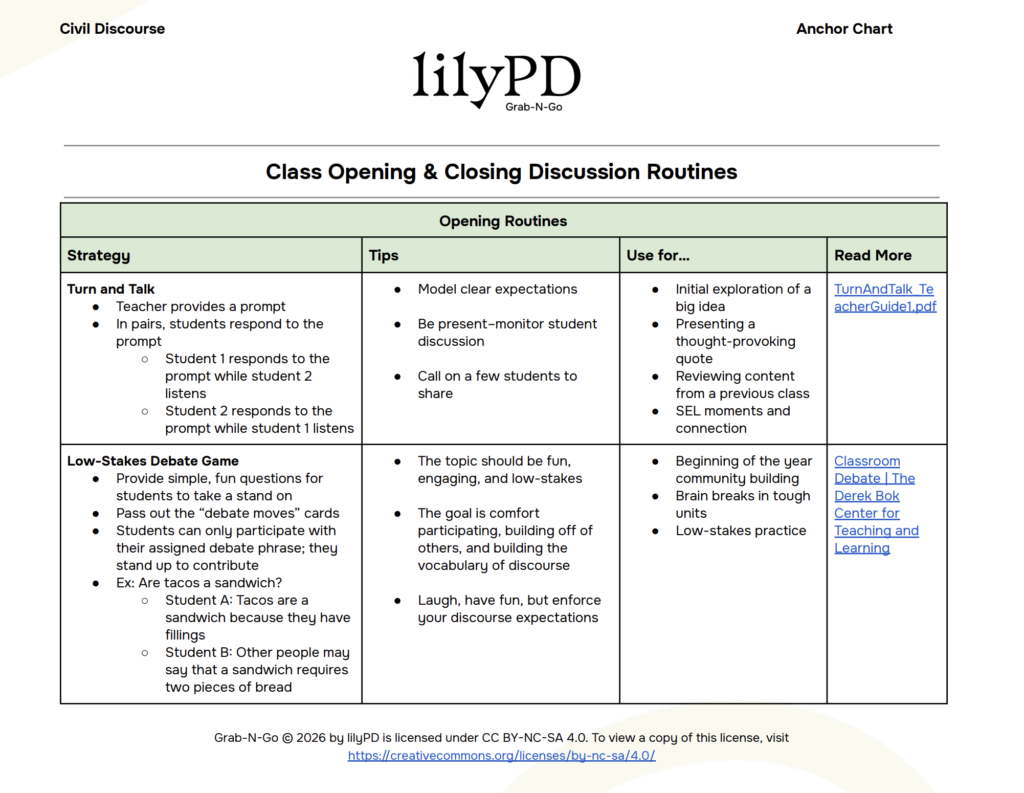
This module addresses the “how-to” of building a classroom culture of trust. It emphasizes scaffolding—transitioning students from low-stakes, “fun” topics (e.g., “Is a hot dog a sandwich?”) to complex historical or contemporary issues. You will also learn to differentiate between three distinct tools in the discourse toolkit: academic discussion, competitive debate, and collaborative dialogue.
In this module you will explore concrete methods for normalizing discourse through daily classroom life. This includes quick Thinking Routines (like Harvard’s +1 routine) and “silent” strategies (such as Table Graffiti and Silent Round Table) designed to engage reserved students. Movement-based strategies like Philosophical Chairs are also introduced to help students visualize shifting perspectives.
This module covers extended, high-impact strategies that mirror real-world civic decision-making. You will learn to facilitate structured experiences like Pinwheel Discussions, Socratic Seminars, and the World Cafe format. It also provides guidance on implementing immersive simulations, including Mock Trials, Mock Elections, and Simulated Congressional Hearings.
The final module addresses practical implementation challenges and long-term sustainability. Develop a professional plan for “when things go sideways” and explore restorative practices to restore classroom trust if a discussion becomes inappropriate or hurtful. In this module you will also prepare to complete the final course narrative assessment, which is the final step before course completion.
Featured course resources
Course Feedback Survey
Help us improve! Please complete this anonymous survey once you have finished the course. We’d love to hear from you!


A microcourse is a short, focused learning experience designed to be completed in manageable segments — so you can fit professional development into your actual schedule, not just your PD days.
Course length varies, but most microcourses are designed to be completed in five hours — and you can pause and return whenever it works for you.
All courses are developed by teachers in collaboration with William & Mary faculty researchers, museum professionals, and other experts. Courses are grounded in learning science and backed by William & Mary’s decades of leadership in civic education. Content is designed to be rigorous and immediately applicable in the classroom.
We’re always adding new courses so please visit our Learn page to view the latest release.
When you complete a lilyPD course, you’ll receive a downloadable certificate worth 5 hours of professional development, accredited by William & Mary’s School of Education.
We ensure all our courses meet the Web Content Accessibility Guidelines (WCAG). This includes:
- Behind the scenes: semantic HTML, full keyboard (tab) navigation, and screen-reader compatibility.
- In the user experience: transcripts for non-text content, ALT text for images, and clear, comprehensible site navigation.
If you have concerns or suggestions for how we can improve our accessibility features, we’d love to hear from you. Please email us at lilypd@wm.edu with the subject line “Accessibility.”
Discover more courses
Continue your professional development journey with these related courses.
Artifact Analysis
Transform your classroom into a site of active, inquiry-driven discovery with this course on artifact analysis. Use artifacts as dynamic evidence that empowers students to question, interpret, and debate history. Through a focus on culturally responsive teaching and practical sourcing—including museum digital collections and 3D printing—you will gain the tools to make history feel tangible and engaging for every learner.


Historical Inquiry in the Classroom
This course provides social studies educators with the practical tools and structures needed to shift from delivering a set of information to facilitating deep, student-led investigation. You will walk away with a comprehensive plan and ready-to-use resources that make meaningful research a daily reality in your classroom, ensuring every student has the skills to analyze information and thoughtfully develop their own conclusions.

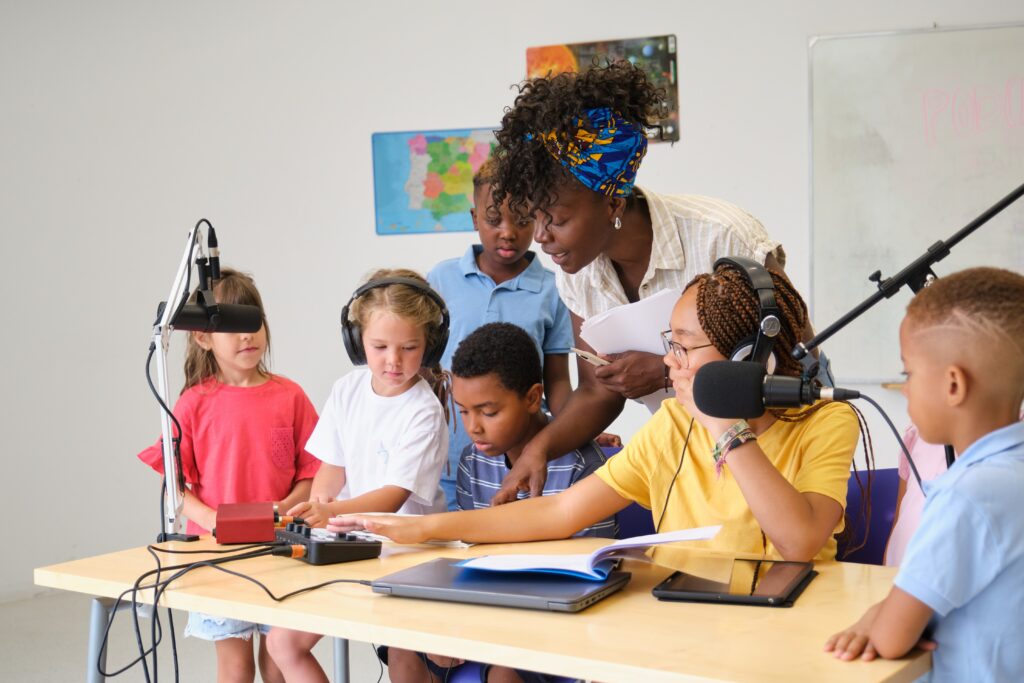
Podcasting for Educators
You don’t need to be a technical wizard to run excellent podcast projects with your students. This course covers the basics — from using podcasts to deepen learning, to guiding students through creating their own — enhancing engagement, deepening learning, and developing your students’ listening skills along the way.
Nonfiction Reading Strategies
Pull back the curtain on the reading process by equipping your students with a permanent toolbox of practical strategies to navigate any text with purpose, confidence, and clarity. By turning invisible mental work into visible, repeatable routines, you will empower your students to move beyond literal retelling and start making real meaning from everything they read.

The Horizon of Independence
As the first course in our three-part series on the American Revolution, the Horizon of Independence helps educators deepen their understanding of early America and the build up to the American Revolution (1607-1776) by exploring inquiry-driven, primary source-based strategies for teaching the complexities and enduring significance of the founding of the United States of America.