
Your learning journey
About this course
Writing Evidence-Based Arguments 101 continues the work of Building Evidence-Based Arguments and takes teachers through what it really takes to write a strong argument from the ground up — starting with real-world WAGOLLs and flash-drafting techniques to beat the blank page, then moving students through strategies for structuring and organizing a piece of argument writing, articulating a clear and powerful claim, and using evidence with confidence.
Built to provide teachers with flexible strategies that can move unit-to-unit and students with strategies that can transfer to writing in any course, Writing Evidence-Based Arguments provides heaps of tools for immediate classroom use. By the end, you’ll walk away with sample unit maps ready to bring the whole framework straight into your own classroom, across grade levels and content areas.
Details
Includes
Shareable PD Certificate
Aligned With
Assessment Types
Course accessibility
What you’ll learn
Master Core Concepts
- Analyze mentor texts (WAGOLLs) across genres of argument writing to identify the essential elements, such as claim, context, audience consideration, evidence, explanation, and counterclaim acknowledgment, that students can study and imitate.
Develop Skills
- Evaluate how students quote, paraphrase, and summarize evidence, and use strategies that help them explain that evidence and build credibility as writers.
- Select strategies that help students articulate clear, specific claims and strengthen them with rebuttals, matching each strategy to students’ needs.
Apply Your Skills in Context
- Apply explicit instructional strategies that help student writers structure and organize their arguments before and during drafting.
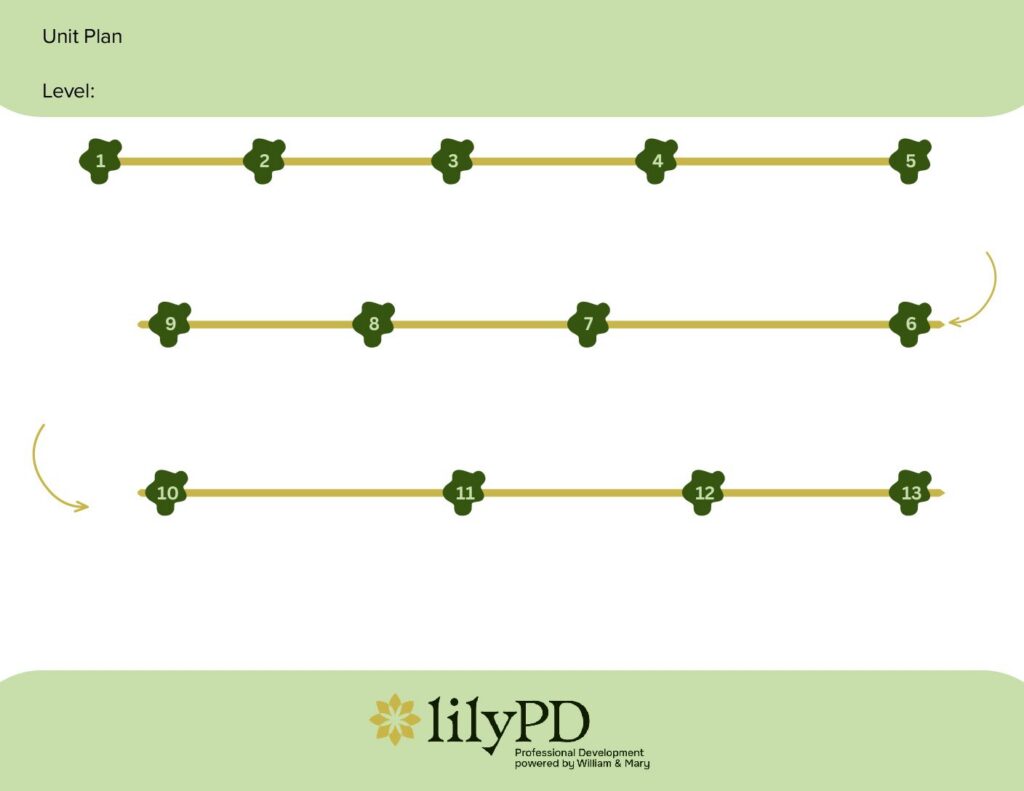
- Envision a unit plan, with a menu of strategies chosen for your own classroom, that shows how you will teach, and scaffold an evidence-based argument writing project.
Demonstrate Your Learning
- Complete a Narrative Assessment reflecting on how you will apply the PBL for Content Literacy Framework in your educational setting.
- Leverage a diverse range of supplementary resources, templates, and classroom-ready strategies.
Skills you’ll gain
Strategies & frameworks you’ll encounter
Ready to transform your project-based learning?
Join educators building the skills to adapt project-based learning (PBL) to your teaching, students, and instructional capacity.
Modules

In this module, you will meet your instructor, Rebekah O’Dell. You will also learn how to navigate the course content and explore the five core principles of strong writing instruction, and see how this course builds upon foundational argument-building concepts.
In this module, you will discover why real-world mentor texts (WAGOLLs) offer a more flexible and authentic foundation for argument writing than rigid formulas. You will also practice practical scaffolds to analyze mentor texts like a writer and use flash drafting to quickly get your ideas onto the page.
In this module, you will explore the essential differences between an argument’s overall structure and its internal organization, discovering why frontloading structure reduces cognitive load and highlights missing content early. You will also practice hands-on strategies—such as Structure Maps, Talk It Out, and transitional techniques—to arrange and connect your paragraphs logically.
In this module, you will evaluate thesis statements against the core characteristics of a well-written claim: being clear, concise, specific, and directly responsive to a central question. You will also test strategies for drafting your claim, experiment with floating its placement across your draft, and use rebuttals to strengthen your overall stance.
In this module, you will address the false-consensus effect by learning how to explicitly draw connections between your evidence and your main ideas for the reader. You will also evaluate when to quote, paraphrase, or summarize sources and utilize structured organizers to ensure your evidence is thoroughly explained.
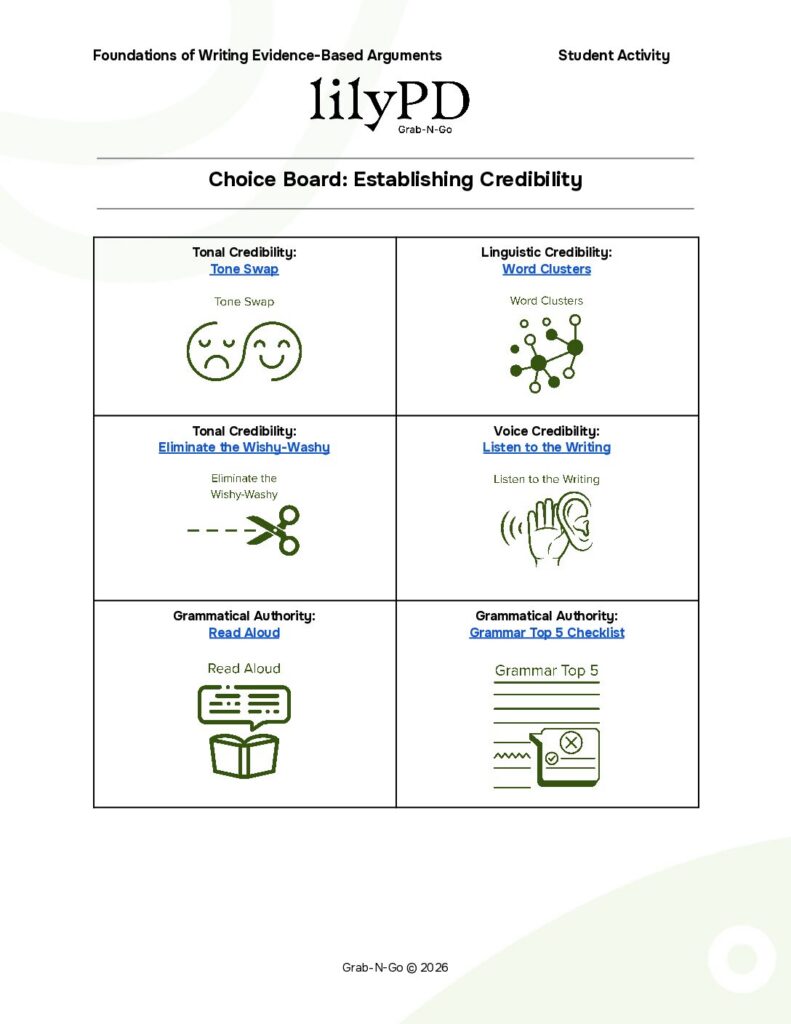
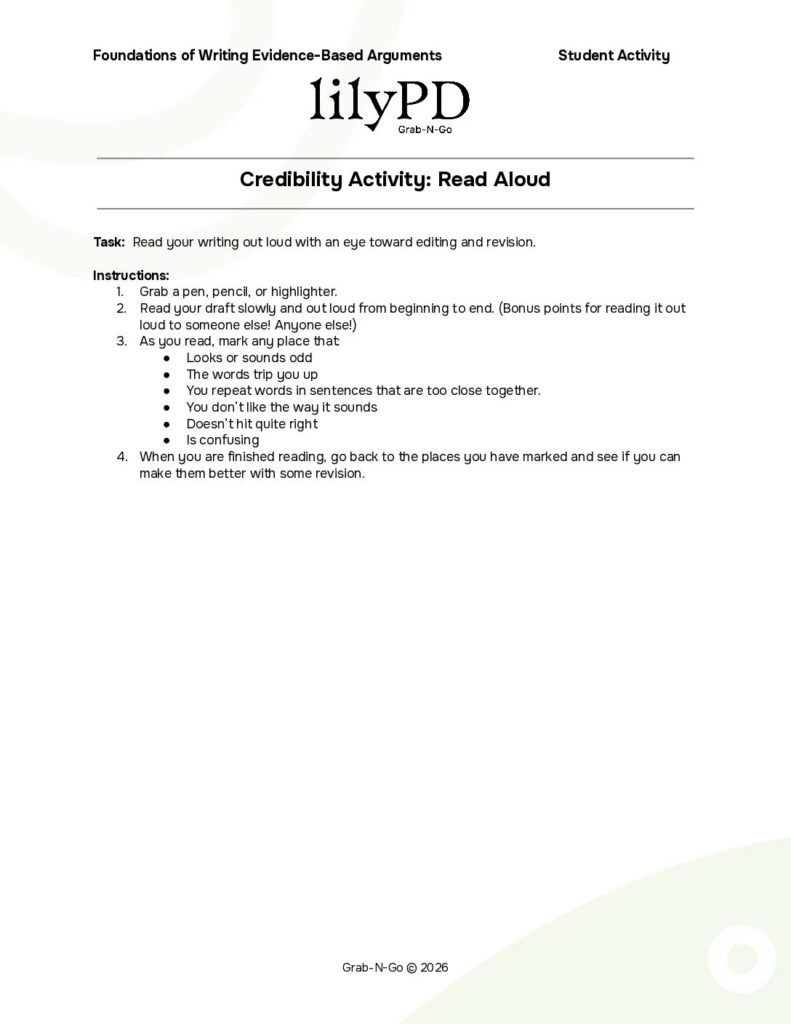
In this module, you will analyze how tone, diction, content depth, evidence selection, and conventions work together to build a writer’s authority on the page. You will also explore a credibility choice board to select targeted strategies that elevate your writing voice and earn reader trust.
In this module, you will review the complete menu of course strategies and analyze sample unit maps across genres such as op-eds, reviews, and open letters. You will then synthesize these tools using the Writing Unit Template to craft a customized argument-writing unit for your classroom. You’ll also complete the narrative assessment for course completion and to receive your PD certificate.
Featured course resources
Course Feedback Survey
Help us improve! Please complete this anonymous survey once you have finished the course. We’d love to hear from you!
No reviews yet. Be the first to share your experience!
A microcourse is a short, focused learning experience designed to be completed in manageable segments — so you can fit professional development into your actual schedule, not just your PD days.
Course length varies, but most microcourses are designed to be completed in five hours — and you can pause and return whenever it works for you.
All courses are developed by teachers in collaboration with William & Mary faculty researchers, museum professionals, and other experts. Courses are grounded in learning science and backed by William & Mary’s decades of leadership in civic education. Content is designed to be rigorous and immediately applicable in the classroom.
We’re always adding new courses so please visit our Learn page to view the latest release.
When you complete a lilyPD course, you’ll receive a downloadable certificate worth 5 hours of professional development, accredited by William & Mary’s School of Education.
We ensure all our courses meet the Web Content Accessibility Guidelines (WCAG). This includes:
- Behind the scenes: semantic HTML, full keyboard (tab) navigation, and screen-reader compatibility.
- In the user experience: transcripts for non-text content, ALT text for images, and clear, comprehensible site navigation.
If you have concerns or suggestions for how we can improve our accessibility features, we’d love to hear from you. Please email us at lilypd@wm.edu with the subject line “Accessibility.”
Discover more courses
Continue your professional development journey with these related courses.
Historical Inquiry in the Classroom
This course provides social studies educators with the practical tools and structures needed to shift from delivering a set of information to facilitating deep, student-led investigation. You will walk away with a comprehensive plan and ready-to-use resources that make meaningful research a daily reality in your classroom, ensuring every student has the skills to analyze information and thoughtfully develop their own conclusions.


Podcasting for Educators
You don’t need to be a technical wizard to run excellent podcast projects with your students. This course covers the basics — from using podcasts to deepen learning, to guiding students through creating their own — enhancing engagement, deepening learning, and developing your students’ listening skills along the way.

Civil Discourse in the Classroom
Transform your classroom into a microcosm of democracy with this course which positions civil discourse as a foundational teaching tool, proven to enhance content knowledge and literacy skills for all students. You will develop a diverse toolkit of strategies to guide students through complex conversations with academic rigor and emotional safety. In the processes, you will equip them with lifelong skills: the ability to listen deeply, reason together, and disagree constructively and respectfully.

Nonfiction Reading Strategies
Pull back the curtain on the reading process by equipping your students with a permanent toolbox of practical strategies to navigate any text with purpose, confidence, and clarity. By turning invisible mental work into visible, repeatable routines, you will empower your students to move beyond literal retelling and start making real meaning from everything they read.

Exhibits in the Classroom
Learn how to use museum exhibits as argumentative texts that support content instruction, student-driven inquiry, and project-based learning. Whether you want to make a field trip more meaningful, strengthen students’ primary source and argument-analysis skills, or guide students as they create exhibit projects for National History Day, Exhibits in the Classroom provides practical strategies, ready-to-use resources, and real-life examples to help you bring the work of museums—and curators—into your classroom.
The Horizon of Independence
As the first course in our three-part series on the American Revolution, the Horizon of Independence helps educators deepen their understanding of early America and the build up to the American Revolution (1607-1776) by exploring inquiry-driven, primary source-based strategies for teaching the complexities and enduring significance of the founding of the United States of America.
Artifact Analysis
Transform your classroom into a site of active, inquiry-driven discovery with this course on artifact analysis. Use artifacts as dynamic evidence that empowers students to question, interpret, and debate history. Through a focus on culturally responsive teaching and practical sourcing—including museum digital collections and 3D printing—you will gain the tools to make history feel tangible and engaging for every learner.