
Being a middle school history teacher is full of “firsts.” The first time students use lockers, the first time they switch classes, and the first time they’re asked to practice historical thinking skills in a serious way. One of my favorite strategies for teaching these skills is through artifacts and hands‑on learning.
But let’s be honest: it isn’t always smooth sailing. One of the biggest frustrations I’ve faced is how quickly students want to rush through everything. I remember watching a group breeze through a primary source analysis in under five minutes. They glanced at a photograph, scribbled down “people standing outside” and “looks old,” then immediately asked, “What does this mean?” or “Is this graded?” or said the dreaded “I don’t get this.”
The thing is, my students weren’t necessarily just ‘being lazy’. They were doing exactly what in some contexts they’d been trained to do: move fast, collect the obvious details, come up with an answer, and wait for the teacher to tell them the “right answer.” This haste, though, can lead to a separation of the ‘learning’ and ‘thinking’ processes, and if students don’t “get it” right away, they often dismiss ‘it’ and move on to something else. Students encounter thousands of artifacts daily: social media posts, advertisements, memes, infographics, and historical documents. And that’s the point of this article: If we are not teaching them to slow down and analyze what they’re seeing, they risk becoming passive consumers instead of critical thinkers.
Why Artifact Analysis Matters
Engaging with artifacts in the classroom can be used as a tool to move from surface‑level observations to deeper questions and reasoned interpretations, and it can be fun too!
Visual literacy is part of this equation. Though visual media surround students, that doesn’t mean that they automatically know how to interpret them. Finding appropriate images, understanding meaning and cultural context, and integrating visuals into academic work are all skills that must be taught (Hattwig et al., 2013). But, for most of us, critical thinking takes time. It requires intention, structure, and practice. Abigail Housen’s decades of research on aesthetic development back this up: visual literacy isn’t innate. It develops through repeated, guided practice and patience.
Enter the Slow, Complexity, Capture Routine
Ron Ritchhart, from Harvard’s Project Zero, takes this further. He argues that creating a “thinking culture” in classrooms is essential for developing the habits of mind students need in an ever-changing world (Ritchhart, 2015).
Project Zero has developed a whole suite of visual thinking routines, and one of my favorites is Slow, Complexity, Capture. It works with any artifact: photographs, poems, political cartoons, data visualizations, paintings, advertisements, TikTok videos, scientific diagrams, you name it. The beauty of the routine is its structure. It guides learners through observation layers they might otherwise skip. It forces them to slow down and notice intricacies.
The Process Unpacked
The routine takes about 10–15 minutes to implement well. Let’s check out how it works with the student-facing directions below:
- SLOW (2–3 minutes of silent observation) Before writing anything, just look. Resist the urge to jump to conclusions. Let your attention wander across the artifact. Notice textures, colors, positioning, facial expressions, empty spaces. This pause trains students to resist the impulse to interpret instantly.
- COMPLEXITY: Surface Observations Document everything directly observable. If it’s a photo, what’s literally in the frame? If it’s a speech, what words are used? Students often want to skip this step because it feels too simple, but observable details become the evidence for later interpretations.
- COMPLEXITY: Hidden Layers Push beyond the obvious by asking:
- What’s absent?
- What choices did the creator make?
- What feelings emerge?
- What patterns appear?
- COMPLEXITY: Contextual Framing Consider the artifact’s world:
- Historical moment and location
- Creator identity and intended audience
- Cultural or political conditions
- How different viewers might interpret it
- CAPTURE Synthesize observations into an interpretation:
- What is the artifact trying to accomplish?
- Whose perspective does it represent?
- Why does it matter?
- What questions remain?
- RE‑EXAMINE and Tie in Content Return to the artifact with your new understanding. What emerges now? How does it connect to the unit content?
As you can see, if we were going to name this routine by its steps, it would be “Slow, Complexity, Complexity, Complexity, Capture, Re-examine”. But that doesn’t have quite the same ring to it, does it?
When you’re introducing this routine to students, be sure to tell them that the point of the “Complexity” parts of the routine is to get a deeper, more comprehensive understanding of the artifact than we had initially.
Seeing the Routine Come Alive
Let’s look at an example from my own classroom:
I shared an image with my sixth graders of a wampum belt, asked them to determine whether it represented conflict or compromise during the Age of Exploration. Their initial reaction was: “a bracelet made of beads.” … I was concerned…But, after working through the routine, they connected the artifact to unit content and even prior units. One student explained the complex patterning and how it could be used during the time period.
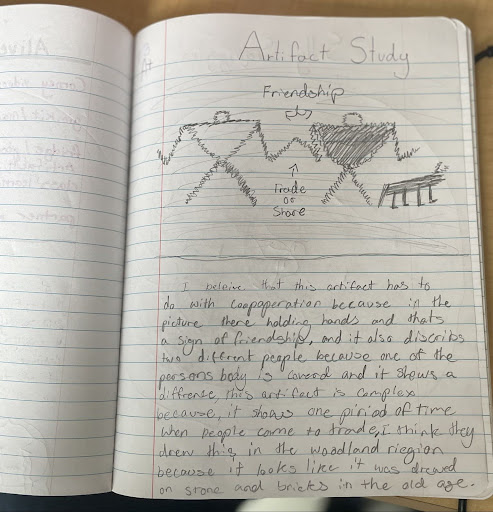
Their final response was exactly the kind of thinking I hope for:
<em>“I believe that this artifact has to do with cooperation because in the picture they’re holding hands and that’s a sign of friendship. It is also describing two different people because one of the person’s bodies is covered and it shows a difference. This artifact is complex because it shows one period of time when people came to trade. I think they drew this in the Woodland region because it looks like it was drawn on stone and bricks in the old age.”</em>
From surface‑level observation to nuanced response that considered purpose, perspective, and power dynamics: that’s the transformation this routine enables.
Why This Works
- It challenges speed culture. The routine manipulates time, slowing it down at first, then structuring it through phases. This makes the curriculum accessible to all learners, including those who need more time to process.
- It develops pattern recognition. Students begin to see how creators make choices, how context shapes meaning, and how their own perspectives influence interpretation. These skills transfer across disciplines. Börner et al. (2019) note that data visualization literacy requires both surface‑level description and deeper contextual analysis. This routine scaffolds both.
- It makes the thinking visible. Ritchhart’s work on cognitive apprenticeship emphasizes making internal thought processes observable (Ritchhart et al., 2011). This routine externalizes analytical thinking, allowing teachers to see and support reasoning.
- It builds intellectual independence. Over time, students develop habits of looking deeper, questioning choices, considering context, and constructing evidence‑based interpretations independently. Yenawine (2013) calls this the internalization of visual thinking strategies.
Next Steps
So, how do you bring this into your classroom? Start small. Pick an artifact you find interesting, maybe a powerful photograph from current events, climate change data visualization or even an everyday object you like. Work through the routine yourself first. Notice how your understanding evolves. That’s what you want for your students.
Then, model your thinking out loud. Housen’s research showed that traditional content delivery rarely results in meaningful learning (Housen, 2002). Project an artifact and narrate your process: “I’m noticing the lighting draws my eye toward this figure… I’m wondering why the creator chose this angle…” Making your thinking audible teaches students how thinking actually works.
Finally, use the routine regularly across subjects. Social studies teachers can use it with primary sources. Science teachers with lab data. English teachers with poems. Math teachers with graphs. Börner et al. (2019) found that data visualization literacy interventions in STEM courses enhance critical thinking. Repetition across disciplines makes the routine powerful. Scaffold gradually with sentence starters like “I think… because…” or “My hypothesis is… and the supporting evidence is…” This helps students build confidence and structure their reasoning.
Conclusion: Artifacts + Routines = Deeper Thinking
When we put artifacts at the center of learning and pair them with structured thinking routines we’re training students to slow down and notice complexity… let’s face it, we’re training them to think! Artifacts can provide the raw material: the photographs, speeches, belts, graphs, and diagrams that demand interpretation. Thinking routines provide the scaffolding: the step‑by‑step process that nudges students past “looks old” into “this shows cooperation because of the hand‑holding imagery.” Put them together and you’re equipping students with lifelong skills for the classroom…and beyond.
References
- Börner, K., Bueckle, A., & Ginda, M. (2019). Data visualization literacy: Definitions, conceptual frameworks, exercises, and assessments. Proceedings of the National Academy of Sciences, 116(6), 1857-1864.
- Hattwig, D., Bussert, K., Medaille, A., & Burgess, J. (2013). Visual literacy standards in higher education: New opportunities for libraries and student learning. portal: Libraries and the Academy, 13(1), 61-89.
- Housen, A. (2002). Aesthetic thought, critical thinking and transfer. Arts and Learning Research Journal, 18(1), 99-132.
- Library of Congress. Why Analyze Primary Sources. Teaching with Primary Sources. https://www.loc.gov/programs/teachers/getting-started-with-primary-sources/guides/
- Ritchhart, R. (2015). Creating cultures of thinking: The 8 forces we must master to truly transform our schools. Jossey-Bass.
- Ritchhart, R., Church, M., & Morrison, K. (2011). Making thinking visible: How to promote engagement, understanding, and independence for all learners. Jossey-Bass.
- Wineburg, S. (2001). Historical thinking and other unnatural acts: Charting the future of teaching the past. Temple University Press.
- Yenawine, P. (2013). Visual thinking strategies: Using art to deepen learning across school disciplines. Harvard Education Press.