
Explore Word Gaps for an Instant Reading Comprehension Boost
My seventh-grade English teacher had an annoying habit. During her class, if we pointed out a word in a book and asked her what it meant, she would say, “The dictionaries are over there,” pointing her long, manicured nail across the room. So, we slogged across the classroom, looked up the words in the dictionary, and read the entries. And, of course, you can guess the result: we still didn’t know what the words meant. Because reading a dictionary definition doesn’t fully explain the meaning of a word. In fact, sometimes after reading the dictionary, we actually understand less.
As we’ve all experienced, dictionaries often use unfamiliar words within the definition, and then we have to look up those words and get caught in a dictionary loop. The words are also defined out of context, and much – maybe most – meaning is derived in context. Students who approach the dictionary with a little bit of knowledge might end up more confused than ever.
But without sufficient word knowledge, readers still struggle to make sense of the text. Knowing words is a prerequisite for comprehension.
Here’s what we know: research shows that vocabulary knowledge is actually the best predictor of reading comprehension (Stahl and Nagy, 2006). But, in order to make sense of a text, students need to understand the meaning of 90%-95% of the words (Nagy and Scott, 2000). That’s a lot of necessary word knowledge. And this is especially true in content area courses – social studies, science, and math – where there is more jargon and specialized terminology necessary to understand the content.
Maybe you’ve been a student like me – hoping an adult will just tell you what you need to know in order to understand your reading. Perhaps, like me, you’ve also been the teacher who didn’t know what to do to help their students beyond simply pointing them toward the dictionary and hoping for the best.
Today, I want to share one strategy we can use to engage students in vocabulary study so they are able to do more in their reading by developing deeper word knowledge.
The Collect and Explore Word Gaps Strategy
A “word gap” is a word or phrase that a student doesn’t know (Beers and Probst, 2015). A word gap might represent a brand new word the student has never seen before or a word they can understand from context but can’t define. The Collect and Explore Word Gaps strategy asks students to bring together the word gaps they find in a text and then explore them. This strategy is about more than simply learning new language, though. Collecting and exploring not only these individual words but the patterns they form can also help readers understand the big ideas of a text.
- Highlight
As you read the text, highlight or underline words and phrases you don’t know. These could be words you’ve never seen before OR words you have seen, but you couldn’t easily define on your own. - Collect
After reading, make a list of these words. - Explore
Briefly define each word, paying attention to words that have multiple definitions. (Vocabulary.com has excellent, accessible definitions!) - Consider
Look at the words you have defined. Ask yourself:- Do these words go together in any way?
- As you look at these words, do any topics or ideas emerge?
- What is the tone of these words? Is there a pattern in the tone?
- Make note of any patterns or connections you see.
- Synthesize
Based on your reflection, what do these specific words tell you about what the writer is trying to say about the topic? Jot down these big ideas. - Re-Read
Re-read the text with these big ideas in mind. What else do you now understand?
Let’s take a look at a couple of examples of the Collect and Explore Word Gaps strategy in action!
Strategy in Action
First, let’s take a look at an elementary student using this strategy.
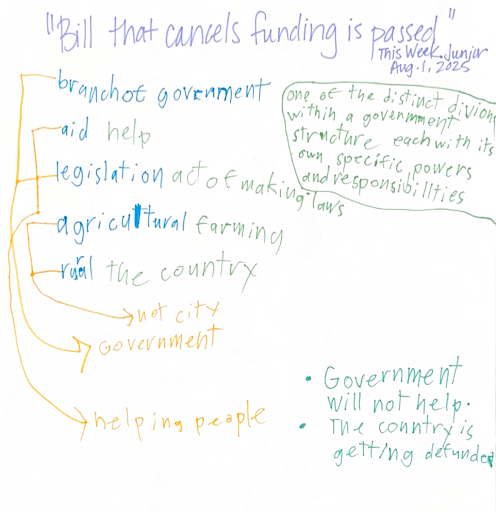
Will is a fourth grader who chose an article from The Week Junior about the rescission bill that passed in Congress in summer 2025. “I have heard these words, but I wasn’t really sure exactly what they meant,” he reflected.
After using the strategy and considering how the strategy specifically helped his understanding, he said, “When I read the article I knew it was about how the government didn’t want to use money to help different groups of people any more. At first, I was just thinking about PBS and Sesame Street. But these words made me realize it’s even bigger than that, and that the government also doesn’t want to help people who farm around the world or live in the country and also need help.”
Will learned a word he didn’t know at all (“rural”) and he reinforced his understanding of other terms he had heard but couldn’t define. But exploring the connections between the words he explored also helped him develop a more nuanced understanding of the article’s main idea.
Now, here’s a secondary example:
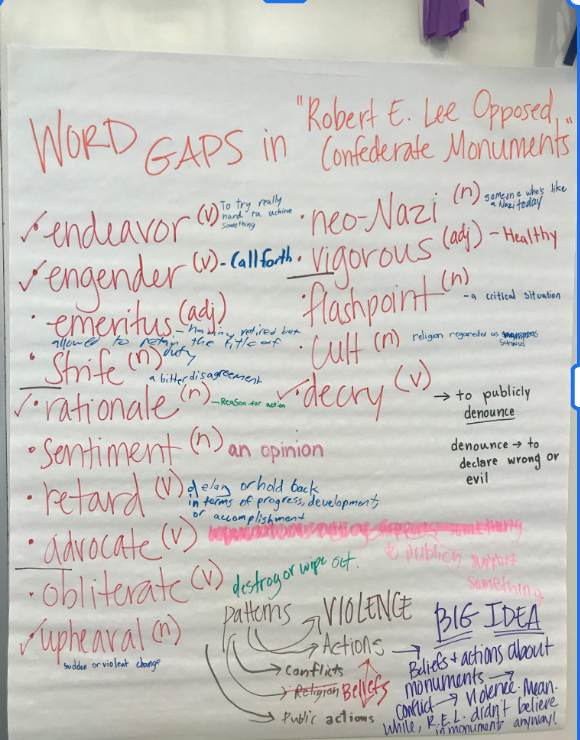
After reading “Robert E. Lee Opposed Confederate Monuments”, students in an eighth grade class used the Collect and Explore Word Gaps strategy together to promote meaningful class discussion. Their initial understanding of the article was a bit superficial – they understood the title and that Robert E. Lee himself didn’t want Confederate monuments to be erected. But they didn’t understand the significance of that fact in relation to contemporary debates about Civil War-era monuments.
Looking at the specific language of the article highlighted violent conflict, action-oriented words, and words that connected to an individual’s deeply-held beliefs. When asked how this connected to the topic of the article, students articulated that different beliefs and actions in relation to controversial historical monuments lead to conflicts which can lead to violence even though the leader of the Confederate army didn’t want these monuments anyway.
As you can see, this new understanding of the article is far more robust and nuanced, and students learned a handful of new words, too!
Why the Strategy Works
- It builds deeper understanding.
The words students do not know or cannot define in a text are often the most specific, intentionally-chosen, topic-dependent language. So, when students can metacognitively identify what they don’t know, gather these words, and put them together in the context of the content, they are learning new words and building a schema for the topic simultaneously. - It’s active.
Notice how this strategy does much more than simply ask students to read a dictionary and passively copy definitions. While students are defining words, they are also using higher-level thinking skills to synthesize and analyze the language of the text – making their newfound knowledge stickier and more useful. - It embraces productive struggle.
There are not right and wrong answers when we collect and explore word gaps. Sometimes that’s scary or frustrating for students who crave black-and-white boundaries. But the beauty of this strategy is that encourages outside-the-box, creative thinking. When students wrestle with the terms and how they connect to both one another and the text’s overall subject, they are creating meaning. And this constructed meaning is far more beneficial to long-term learning than just giving students the answers.
Productive struggle is very uncomfortable for students at first. That’s okay! Encourage them by modeling the process, providing the scaffold of a partner or small group, and reminding them that you can’t explore “wrong”. The only wrong kind of exploration is one that doesn’t happen at all.
What Are Your Next Steps?
Are you ready to get started with the Collect and Explore Word Gaps strategy? Here are some ideas for getting started.
- Try it yourself!
Grab an article you’ve never read before and try the strategy yourself! Nudge yourself to find words and phrases you don’t fully know or understand. See what new insights you can glean by going through this process! Consider how it might help your students! - Use the strategy in small groups!
A great way to try this strategy on for size is to allow students to use it as a group first. Show your students your model as you explain the strategy. Then, give them a text to read in a small group, asking them to collect and explore word gaps. Each group can create their own word gap exploration and then share out, comparing what different groups discovered through the process. - Have students collect and explore word gaps in a small text on their own.
Help your students get started using this strategy with a small chunk of text first – a section of a textbook, part of an article. Allow them to explore words and build connections in micro to learn the process before moving to longer texts! This will build students’ confidence with the strategy.